Market Snapshot: Artificial Intelligence (AI)

As recently as a decade or two ago, the concept of artificial intelligence (AI) becoming a part of our everyday lives seemed like a bit of a stretch to the average person, however, today many of us use it to accomplish everyday tasks. Whether its Siri answering your questions, Netflix recommending what to watch, or Nest knowing just how warm you like your house, AI has become a part of our lives.

To quantify this, MarketsandMarkets reports that the artificial intelligence market was valued at $21.5 billion in 2018 and is expected to reach $190.6 billion by 2025, at a compound annual growth rate (CAGR) of 36.6%. This growth is largely driven by the increasing adoption of cloud-based applications and services, and an increase in demand for intelligent virtual assistants. Whereas the major restraint for the market is surprisingly human, the limited number of AI technology experts is seen as a major restraint. Furthermore, concerns regarding data privacy and the unreliability of AI algorithms are also seen as pain points within the market. Underlying opportunities in the artificial intelligence market include improving operational efficiency in the manufacturing industry and the adoption of AI to improve customer service.

While we see the use of AI growing in our daily lives, the manufacturing industry is expected to grow at the highest CAGR – AI-based solutions are adopted in manufacturing facilities to improve the productivity by maximizing asset utilization, minimizing downtime, and improving machine efficiency. The enabling concepts of deep learning, natural language processing, context awareness, and computer vision are the major technologies used for data mining, image analysis, signal analysis, decision-making, and execution. Frost & Sullivan also points to the evolution of AI as the industry has shifted away from developing intelligent devices to addressing the next goal of developing AI solutions that can learn from data, just as humans do. In November 2019 the Department of Energy announced  $15 Million for Development of Artificial Intelligence and Machine Learning Tools. The major players in this market include Intel (US), NVIDIA (US), Xilinx (US), Samsung (South Korea), Facebook (US), Micron(US), IBM (US), Google (US), Microsoft (US), and AWS (US).

Healthcare is another vertical that is rapidly adopting and seeing the benefits of AI, Frost & Sullivan expects AI and cognitive computing to generate savings of over $150 billion for the healthcare industry by 2025. Analysts see automated disease prediction, personalization of treatment pathways, intuitive claims management, and real-time supply chain management, as potential benefits of AI. However, the uptake in healthcare IT tends to be slow.

In early 2019 the Defense Department (DoD) launched its American Artificial Intelligence Strategy in conjunction with an Executive Order from the White House. The Joint Artificial Intelligence Center (JAIC) is the DoD’s Artificial Intelligence (AI) Center of Excellence that integrates technology development, policy, knowledge, processes and relationships to ensure growth in this area. According to MarketsandMarkets, AI in the military market was valued at $5.54 billion in 2016 and is projected to reach $18.82 billion by 2025, at a CAGR of 14.75% during the forecast period. Within the defense sector, AI is able to handle massive amounts of military data in a more efficient manner as compared to conventional systems. Analysts note that this improves the self-control, self-regulation, and self-actuation abilities of combat systems, using inherent computing and decision-making capabilities. Additionally, increases in funding from military research agencies and a rise in R&D activities to develop advanced AI systems are major driving factors in the adoption of AI systems in the military sector. Based on application, artificial intelligence in military market has been classified into information processing, warfare platforms, threat monitoring & situational awareness, planning & allocation, cyber security, simulation & training, logistics & transportation, target recognition, battlefield healthcare, and others (NBC scenario monitoring and fire monitoring).  However, the unreliability of AI algorithms and unavailability of structured data are key challenges to the growth of the artificial intelligence in military market.

Key players operating in the artificial intelligence in military market range from defense contractors to software firms, including: Lockheed Martin (US), Raytheon (US), IBM (US), BAE Systems (UK), Thales Group (France), NVIDIA (US), Leidos (US), SAIC (US), Northrop Grumman (US), SparkCognition (US), Harris Corporation (US), General Dynamics (US), and Charles River Analytics (US).

Interested in learning more? Try attending an AI conference or event in 2020!
Share this article:

Email
X
LinkedIn

Click below to learn about our market research services

Stay in the Know with Dawnbreaker®

Receive valuable industry insights such as our Market Snapshots, SBIR/STTR & TABA updates, & webinar announcements.

Fusion Energy Overview

Fusion is a potential energy source and occurs when one or more lighter elements combine to form a heavier element, releasing energy in the process. [1] Devices designed to harness this energy are known as fusion reactors. [2]   A future fusion plant could use the heat produced by the fusion reaction to produce steam to drive turbines or generators that produce electricity. [3] For almost a century, scientists around the globe have been looking to recreate and harness the power of fusion energy. [4]  

Tokamak
Source: ITER

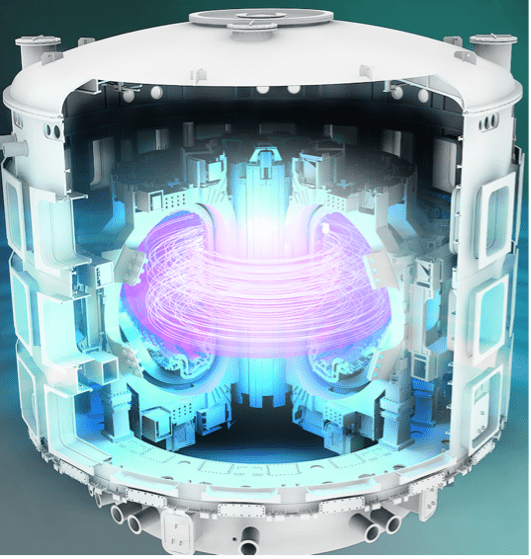
There are two commonly pursued technologies to create and control plasma. Magnetic confinement uses strong magnets to contain plasma. A widely used configuration known as a tokamak[5] uses powerful magnets to confine the plasma within a toroidal reaction vessel, with the magnetic fields keeping the plasma away from the walls of the vessel to prevent damage and unintended cooling of the plasma.[6]  

Examples of U.S. companies developing magnetic confinement systems are Commonwealth Fusion Systems, TAE Technologies, Tokamak Energy, Helion Energy, and Thea Energy. Inertial confinement uses high-power lasers or electrical discharges to compress a small capsule of fusion fuel to extreme temperatures and pressures for a short time. This approach is used, for example, in the National Ignition Facility at the U.S. Department of Energy (DOE) Lawrence Livermore National Laboratory. [7] Examples of U.S. companies developing inertial confinement systems are Xcimer Energy, Focused Energy, ZAP Energy, and Shine Technologies. In addition to these methods, several companies such as General Fusion,  are pursuing various other pathways to try to create and control fusion reactions, including a hybrid of both magnetic and inertial confinement approaches. [8]

Various fusion fuels are used to power these pursued pathways. According to the U.S. Department of Energy, once developed, first-generation fusion plants may likely use a combination of abundant deuterium and lithium as fuel. [9] Deuterium, lithium and tritium Deuterium-tritium is a highly studied fusion fuel and a likely basis for the first fusion power plants.[10] Lithium is a critical resource for fusion because of its material properties. Lithium is used to breed tritium, the key fuel for fusion. [11] The rare lithium-6 form of the metal, which makes up only 7.5 per cent of all naturally occurring lithium, is the most efficient for sustaining the fusion process. [12] Li-6 is banned in the U.S. because of the harmful mercury waste it generates. [13] So most fusion power concepts rely on “enriched” lithium, where the Li-6 content has been boosted. [14]

Several companies are investing in efforts aimed at commercializing fusion energy. [15] Many of these companies are startups that have raised over $100 million in the past few years. [16]  The global fusion energy market size is projected to reach $611.8 billion by 2034, expanding at a CAGR of 5.56% from 2025 to 2034. [17] 

Current State - Projections of the time to putting Fusion Energy on the Grid

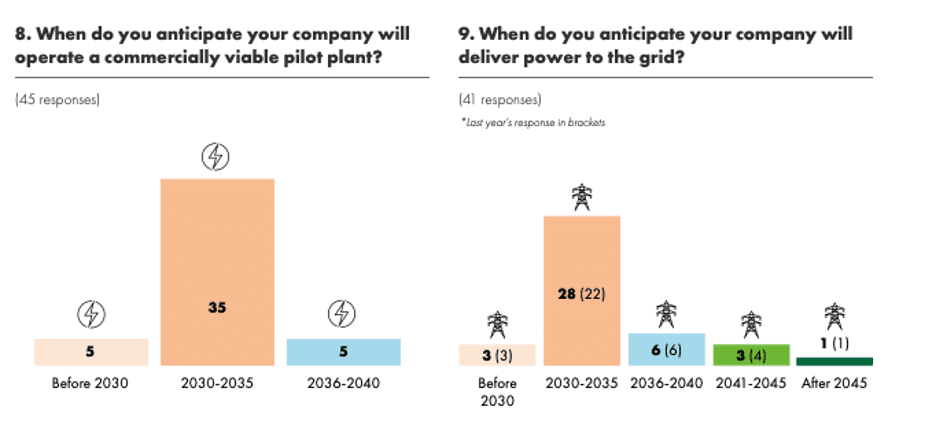
As of October 2025, fusion reactors remain pre-commercial, with no system yet producing net energy. Fusion energy stakeholders provide varying timelines as to when fusion energy will become technically feasible as an energy source for the electrical grid and when it will become commercially viable.  Projections range from 10 years to several decades in the future. [18]   Some companies are claiming that they will achieve commercial fusion energy in the next few years[19] while other stakeholders and experts said fusion energy will take more than 20 years. The Fusion Industry Association reported that many commercial companies predict fusion industry will be commercially viable in the 2030’s time frame. [19] 

Source: The Global Fusion Industry in 2025—Fusion Industry Association

Other stakeholders and experts believe fusion energy might put electricity on the grid in 10 to 20 years, however, significant resources are required to do so.[20] The Figure below illustrates commercialization risks that fusion energy will face on the road to commercial deployment. According to the U.S. Department of Energy, the aspirational timeline as shown is strongly dependent on the level of both public and private investments. [21]

Commercialization risks for fusion

Source. U.S. Department of Energy, Fusion Energy Strategy 2024

Download the Dawnbreaker® OTA Report

Click below to download a copy of the Dawnbreaker® OTA Report. 

DoD Transition Information Packet (TIP)®

The Transition Information Packet (TIP) is a market research report specifically developed for small businesses working with the Department of Defense.

Customized Market Research (CMR)®

Filling in the gaps in your commercialization strategy….

The CMR provides our team with the greatest flexibility in addressing gaps in the information you need to refine your commercialization strategy. Based strictly on secondary literature, the market researcher can look for information that will help you understand changes in government regulations, market dynamics, emerging solutions, sources of funding, points of contact and other challenges you pose. Based on the information gathered, a business strategist will add comments throughout regarding the implications of the information for your strategy.

LICA Licensee Analysis®

Who will take the best care of your baby?

You’ve done a great job with your R&D. You’ve been careful to protect your intellectual property – but those next steps to bring the product to market seem out of reach. There’s too much competition, scale up would be too expensive – so you’ve decided to license-out your intellectual property. The challenge before you is to find the best licensee to bring your baby to market. Let us help you. We will profile organizations that frequently cite your patents and dig deeper to determine their financial health, technology and market synergies, and experience with licensing-in.

Commercial Potential Assessment (CPA)

Be wary of big numbers!

You’ve done a great job with your R&D. You’ve been careful to protect your intellectual property – but those next steps to bring the product to market seem out of reach. There’s too much competition, scale up would be too expensive – so you’ve decided to license-out your intellectual property. The challenge before you is to find the best licensee to bring your baby to market. Let us help you. We will profile organizations that frequently cite your patents and dig deeper to determine their financial health, technology and market synergies, and experience with licensing-in.

Competitor Analysis

Your customers know your competitors! Do you?

Maybe you believe that you don’t have any competition, but your customers know better! Their needs are being addressed now – perhaps not as well, but if there is a need, someone is providing a solution. Learn about the competition and be prepared to differentiate your solution from that of others. Dawnbreaker’s competitor analysis contrasts your competition on specifications, performance and price. Armed with this information we can help you create a compelling value proposition.

Developing Network Contacts (DevNC)

When you need to reach out...

There are times when you need to reach out to others – whether you are looking for potential customers, potential partners, or potential investors. But who should you call…and how do you address your fear of contacting them. The DevNC is a unique market research tool designed to provide you with between 25 and 30 Points of Contact (PoC). With each POC, information is included that provides insight about the person’s role. Depending on their position, other information commonly included relates to their background, articles that they have written, conference presentations and other pertinent information. This type of information enables you to customize your correspondence. Contact information is also included  – typically LinkedIn, email and phone number.

We are in the process of updating the Energy Portal

Please check back soon for access to our updated Energy Portal.