Market Snapshot: Autonomous & Semi-Autonomous Vehicles

The automobile and driving have been cornerstones of both industry and daily life for over a century. However, in recent years more and more portions of this way of life have become automated. The National Highway Traffic Safety Administration (NHTSA) reports that the continuing goal of automotive technology is to deliver increasing safety benefits and Automated Driving Systems (ADS) where fully automated cars and trucks will drive us, instead of us driving them. Enabling technologies have been incrementally introduced and accepted ranging from cruise control to lane assist technology.

Driven by various factors, including the need for ease in driving and the increasing concern for safety and security, which lead to demand for high-end technology resulting in the increased demand for semi-autonomous and autonomous vehicles, MarketsandMarkets reports that semi-autonomous vehicles market volume was estimated to be 10.5 Million Units in 2017 and is projected to reach 27.7 Million Units by 2022 growing at a compound annual growth rate (CAGR) of 21.36%. The autonomous vehicles market is estimated to be 0.5 Million Units in 2025 and is projected to reach 6.9 Million Units by 2030 growing at a CAGR of 68.94% from 2025 to 2030. When quantified from a revenue perspective, Allied Market Research reports that global autonomous vehicle market size is forecast to be valued at $54.23 billion in 2019, and is expected to reach $556.67 billion by 2026, registering a CAGR of 39.47% from 2019 to 2026. These vehicles use artificial intelligence (AI) software, light detection & ranging (LiDAR), and RADAR sensing technology.

While sensors play many roles in the automotive market, autonomous and semi-autonomous vehicles are a driving force in their use. These vehicles combine sensors and software to control, navigate, and drive the vehicle, and use LiDAR and RADAR sensors for its operation. The majority of self-driving systems create and maintain an internal map of their surroundings, based on a wide array of sensors. BCC Research reports that the global market for automobile sensors should grow from $35.4 billion in 2018 to $66.2 billion by 2023 at a CAGR of 13.4% from 2018 to 2023.

From a regional perspective, North America is expected to dominate the semi-autonomous vehicles market, in terms of volume, followed by Europe and Asia Pacific. Semi-autonomous vehicles volumes have increases in recent years, with OEMs catering not only to the domestic demand but also to the overseas demand. Moreover, in 2025 North America is likely to lead the autonomous vehicles market in terms of volume followed by Europe and Asia Pacific, as key technology innovators such as Google, Microsoft, and Delphi automotive are significantly investing in and testing the technology to commercialize the same.

However, barriers in this market include the lack of infrastructure to support autonomous cars in developing nations, concerns regarding cyber security and safety of the personal data of the users, and consumers’ hesitation to accept fully autonomous cars are some of the restraints that might hinder the growth of autonomous and semi-autonomous vehicles. Frost & Sullivan reports that while technology development and the lack of a robust regulatory framework are the greatest obstacles in this market today, the need to understand consumer demand and the use of data for generating revenues will be the key challenge to address for OEMs in the future. To achieve this, analysts believe that OEMs will need to focus on developing flexible, autonomous platforms capable of providing multiple vehicle types for specific use cases to be successful in the future.

To learn more, consider attending a conference in 2020 – Autonomous Vehicles and Machines 2020 kicks off the year in January, Autonomous Vehicles 2020 takes place in February, and the Autonomous Vehicles Test & Development Symposium will take place alongside Automotive Testing Expo in October.
Share this article:

Email
X
LinkedIn

Click below to learn about our market research services

Stay in the Know with Dawnbreaker®

Receive valuable industry insights such as our Market Snapshots, SBIR/STTR & TABA updates, & webinar announcements.

Fusion Energy Overview

Fusion is a potential energy source and occurs when one or more lighter elements combine to form a heavier element, releasing energy in the process. [1] Devices designed to harness this energy are known as fusion reactors. [2]   A future fusion plant could use the heat produced by the fusion reaction to produce steam to drive turbines or generators that produce electricity. [3] For almost a century, scientists around the globe have been looking to recreate and harness the power of fusion energy. [4]  

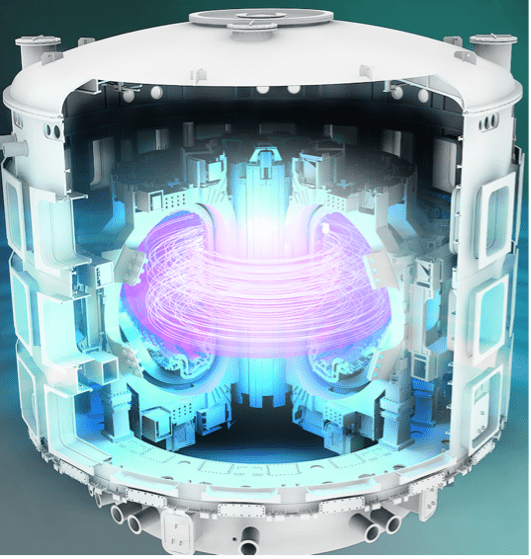
Tokamak
Source: ITER

There are two commonly pursued technologies to create and control plasma. Magnetic confinement uses strong magnets to contain plasma. A widely used configuration known as a tokamak[5] uses powerful magnets to confine the plasma within a toroidal reaction vessel, with the magnetic fields keeping the plasma away from the walls of the vessel to prevent damage and unintended cooling of the plasma.[6]  

Examples of U.S. companies developing magnetic confinement systems are Commonwealth Fusion Systems, TAE Technologies, Tokamak Energy, Helion Energy, and Thea Energy. Inertial confinement uses high-power lasers or electrical discharges to compress a small capsule of fusion fuel to extreme temperatures and pressures for a short time. This approach is used, for example, in the National Ignition Facility at the U.S. Department of Energy (DOE) Lawrence Livermore National Laboratory. [7] Examples of U.S. companies developing inertial confinement systems are Xcimer Energy, Focused Energy, ZAP Energy, and Shine Technologies. In addition to these methods, several companies such as General Fusion,  are pursuing various other pathways to try to create and control fusion reactions, including a hybrid of both magnetic and inertial confinement approaches. [8]

Various fusion fuels are used to power these pursued pathways. According to the U.S. Department of Energy, once developed, first-generation fusion plants may likely use a combination of abundant deuterium and lithium as fuel. [9] Deuterium, lithium and tritium Deuterium-tritium is a highly studied fusion fuel and a likely basis for the first fusion power plants.[10] Lithium is a critical resource for fusion because of its material properties. Lithium is used to breed tritium, the key fuel for fusion. [11] The rare lithium-6 form of the metal, which makes up only 7.5 per cent of all naturally occurring lithium, is the most efficient for sustaining the fusion process. [12] Li-6 is banned in the U.S. because of the harmful mercury waste it generates. [13] So most fusion power concepts rely on “enriched” lithium, where the Li-6 content has been boosted. [14]

Several companies are investing in efforts aimed at commercializing fusion energy. [15] Many of these companies are startups that have raised over $100 million in the past few years. [16]  The global fusion energy market size is projected to reach $611.8 billion by 2034, expanding at a CAGR of 5.56% from 2025 to 2034. [17] 

Current State - Projections of the time to putting Fusion Energy on the Grid

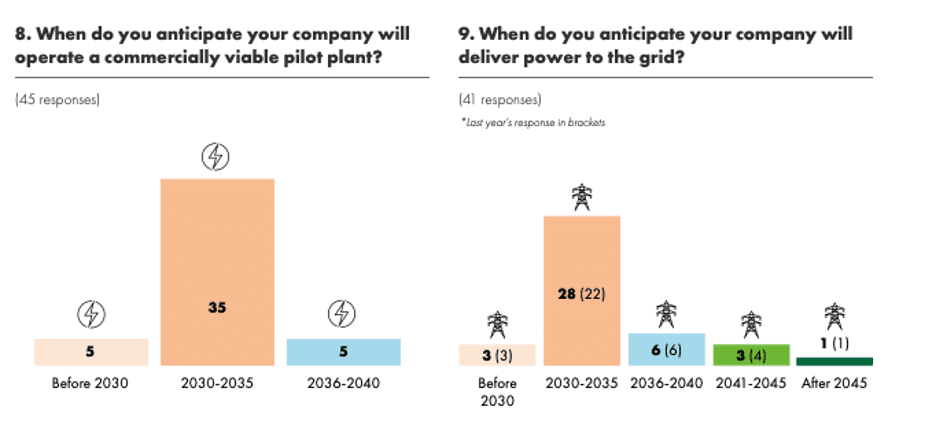
As of October 2025, fusion reactors remain pre-commercial, with no system yet producing net energy. Fusion energy stakeholders provide varying timelines as to when fusion energy will become technically feasible as an energy source for the electrical grid and when it will become commercially viable.  Projections range from 10 years to several decades in the future. [18]   Some companies are claiming that they will achieve commercial fusion energy in the next few years[19] while other stakeholders and experts said fusion energy will take more than 20 years. The Fusion Industry Association reported that many commercial companies predict fusion industry will be commercially viable in the 2030’s time frame. [19] 

Source: The Global Fusion Industry in 2025—Fusion Industry Association

Other stakeholders and experts believe fusion energy might put electricity on the grid in 10 to 20 years, however, significant resources are required to do so.[20] The Figure below illustrates commercialization risks that fusion energy will face on the road to commercial deployment. According to the U.S. Department of Energy, the aspirational timeline as shown is strongly dependent on the level of both public and private investments. [21]

Commercialization risks for fusion

Source. U.S. Department of Energy, Fusion Energy Strategy 2024

Download the Dawnbreaker® OTA Report

Click below to download a copy of the Dawnbreaker® OTA Report. 

DoD Transition Information Packet (TIP)®

The Transition Information Packet (TIP) is a market research report specifically developed for small businesses working with the Department of Defense.

Customized Market Research (CMR)®

Filling in the gaps in your commercialization strategy….

The CMR provides our team with the greatest flexibility in addressing gaps in the information you need to refine your commercialization strategy. Based strictly on secondary literature, the market researcher can look for information that will help you understand changes in government regulations, market dynamics, emerging solutions, sources of funding, points of contact and other challenges you pose. Based on the information gathered, a business strategist will add comments throughout regarding the implications of the information for your strategy.

LICA Licensee Analysis®

Who will take the best care of your baby?

You’ve done a great job with your R&D. You’ve been careful to protect your intellectual property – but those next steps to bring the product to market seem out of reach. There’s too much competition, scale up would be too expensive – so you’ve decided to license-out your intellectual property. The challenge before you is to find the best licensee to bring your baby to market. Let us help you. We will profile organizations that frequently cite your patents and dig deeper to determine their financial health, technology and market synergies, and experience with licensing-in.

Commercial Potential Assessment (CPA)

Be wary of big numbers!

You’ve done a great job with your R&D. You’ve been careful to protect your intellectual property – but those next steps to bring the product to market seem out of reach. There’s too much competition, scale up would be too expensive – so you’ve decided to license-out your intellectual property. The challenge before you is to find the best licensee to bring your baby to market. Let us help you. We will profile organizations that frequently cite your patents and dig deeper to determine their financial health, technology and market synergies, and experience with licensing-in.

Competitor Analysis

Your customers know your competitors! Do you?

Maybe you believe that you don’t have any competition, but your customers know better! Their needs are being addressed now – perhaps not as well, but if there is a need, someone is providing a solution. Learn about the competition and be prepared to differentiate your solution from that of others. Dawnbreaker’s competitor analysis contrasts your competition on specifications, performance and price. Armed with this information we can help you create a compelling value proposition.

Developing Network Contacts (DevNC)

When you need to reach out...

There are times when you need to reach out to others – whether you are looking for potential customers, potential partners, or potential investors. But who should you call…and how do you address your fear of contacting them. The DevNC is a unique market research tool designed to provide you with between 25 and 30 Points of Contact (PoC). With each POC, information is included that provides insight about the person’s role. Depending on their position, other information commonly included relates to their background, articles that they have written, conference presentations and other pertinent information. This type of information enables you to customize your correspondence. Contact information is also included  – typically LinkedIn, email and phone number.

We are in the process of updating the Energy Portal

Please check back soon for access to our updated Energy Portal.