Market Snapshot: Additive Manufacturing

From schools and public libraries to the Department of Defense and industry, additive manufacturing and 3D printing technology is being used everywhere.  Additive manufacturing (AM) encompasses many technologies, including subsets like 3D printing, rapid prototyping, direct digital manufacturing, layered manufacturing and additive fabrication. As a process, additive manufacturing uses a computer-aided design (CAD) file to precisely control layer-by-layer, or point-by-point, buildup of material into three dimensional objects. The National Center for Manufacturing Sciences (NCMS) sees AM an emerging technology with many promising applications for both industry and Government including:

  • Rapid iterations of prototyping, reducing time and money for design
  • Reduction in wait time
  • Enabling of just in time manufacturing on site at locations
  • Support of immediate readiness
  • Small, unique production runs

In July of 2019 the U.S. Department of Energy (DOE) published Solving Industry’s Additive Manufacturing Challenges providing a comprehensive look at AM in the U.S. and the Department’s role in this dynamic market. DOE estimates that AM might reduce waste and materials costs by nearly 90% and cut manufacturing energy use in half when compared to traditional manufacturing practices. DOE’s Advanced Manufacturing Office (AMO) provides information on funding opportunities, roadmaps, strategic plans, and events and its AMO Multi-Year Program Plan (FY 2017- FY 2021) includes additive manufacturing as a technology area covered in the plan.

Within the U.S. Department of Defense (DoD), an integrated DoD Additive Manufacturing (AM) Roadmap was published in December 2016 and strategic implementation plans for AM have been independently produced by the USAF and the U.S. Department of the Navy (DON), and the U.S. Army has also developed a draft AM technology report. While each Service has its own plan and system for AM research, all the services are members of the National Manufacturing Institutes, or “Manufacturing USA” which is a public-private partnership, jointly funded by government and private industry, focused on advanced manufacturing, including additive manufacturing. Through Manufacturing USA the America Makes Institute in Youngstown, OH is focused on additive manufacturing (AM) and has funded more than 60 projects since it was founded in 2012. The 2020 Military Additive Manufacturing Summit & Technology Showcase is coming up in February.

To help quantify this market, BCC Research reports that the global market for 3D printing reached $10.2 billion in 2019 and should reach $27.5 billion by 2024, at a compound annual growth rate (CAGR) of 22.0% for the period of 2019-2024. As a whole, the global manufacturing industry grew at a 3% rate year-on-year in 2019, contributing 30% to the global GDP. This total industry growth is attributed to new technologies including automation, 3D printing and a marked increase in automobile and electronics production. From a capabilities standpoint, the ability to 3D print metal materials is an exciting ongoing development – given that the process uses no tooling, is almost fully automated, and adds rather than removes material to allow for more optimized geometries makes metal 3D printing into an attractive option for parts that might typically be very difficult or expensive to manufacture, including legacy parts, line automation tools, and functional cast prototypes manufacturing. These features are especially attractive in automotive and defense applications.

Key participants in the additive manufacturing space include 3D Systems Inc., General Electric, EnvisionTEC, Mcor Technologies Ltd., Optomec Inc., Stratasys Ltd, EOS GmbH, The ExOne Company and MakerBot Industries, LLC. While this has been a highly concentrated industry, AMFG’s Additive Manufacturing Landscape offers a detailed overview of the key players and categories within the additive manufacturing industry and includes 171 different players.

Hoping to learn more? Try attending an upcoming additive manufacturing event in 2020!
Share this article:

Email
X
LinkedIn

Click below to learn about our market research services

Stay in the Know with Dawnbreaker®

Receive valuable industry insights such as our Market Snapshots, SBIR/STTR & TABA updates, & webinar announcements.

Fusion Energy Overview

Fusion is a potential energy source and occurs when one or more lighter elements combine to form a heavier element, releasing energy in the process. [1] Devices designed to harness this energy are known as fusion reactors. [2]   A future fusion plant could use the heat produced by the fusion reaction to produce steam to drive turbines or generators that produce electricity. [3] For almost a century, scientists around the globe have been looking to recreate and harness the power of fusion energy. [4]  

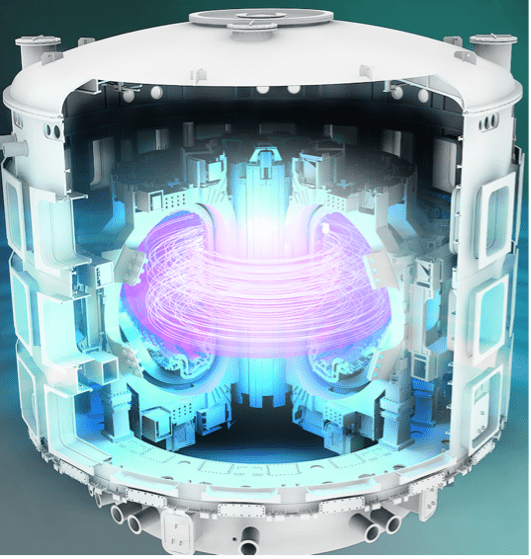
Tokamak
Source: ITER

There are two commonly pursued technologies to create and control plasma. Magnetic confinement uses strong magnets to contain plasma. A widely used configuration known as a tokamak[5] uses powerful magnets to confine the plasma within a toroidal reaction vessel, with the magnetic fields keeping the plasma away from the walls of the vessel to prevent damage and unintended cooling of the plasma.[6]  

Examples of U.S. companies developing magnetic confinement systems are Commonwealth Fusion Systems, TAE Technologies, Tokamak Energy, Helion Energy, and Thea Energy. Inertial confinement uses high-power lasers or electrical discharges to compress a small capsule of fusion fuel to extreme temperatures and pressures for a short time. This approach is used, for example, in the National Ignition Facility at the U.S. Department of Energy (DOE) Lawrence Livermore National Laboratory. [7] Examples of U.S. companies developing inertial confinement systems are Xcimer Energy, Focused Energy, ZAP Energy, and Shine Technologies. In addition to these methods, several companies such as General Fusion,  are pursuing various other pathways to try to create and control fusion reactions, including a hybrid of both magnetic and inertial confinement approaches. [8]

Various fusion fuels are used to power these pursued pathways. According to the U.S. Department of Energy, once developed, first-generation fusion plants may likely use a combination of abundant deuterium and lithium as fuel. [9] Deuterium, lithium and tritium Deuterium-tritium is a highly studied fusion fuel and a likely basis for the first fusion power plants.[10] Lithium is a critical resource for fusion because of its material properties. Lithium is used to breed tritium, the key fuel for fusion. [11] The rare lithium-6 form of the metal, which makes up only 7.5 per cent of all naturally occurring lithium, is the most efficient for sustaining the fusion process. [12] Li-6 is banned in the U.S. because of the harmful mercury waste it generates. [13] So most fusion power concepts rely on “enriched” lithium, where the Li-6 content has been boosted. [14]

Several companies are investing in efforts aimed at commercializing fusion energy. [15] Many of these companies are startups that have raised over $100 million in the past few years. [16]  The global fusion energy market size is projected to reach $611.8 billion by 2034, expanding at a CAGR of 5.56% from 2025 to 2034. [17] 

Current State - Projections of the time to putting Fusion Energy on the Grid

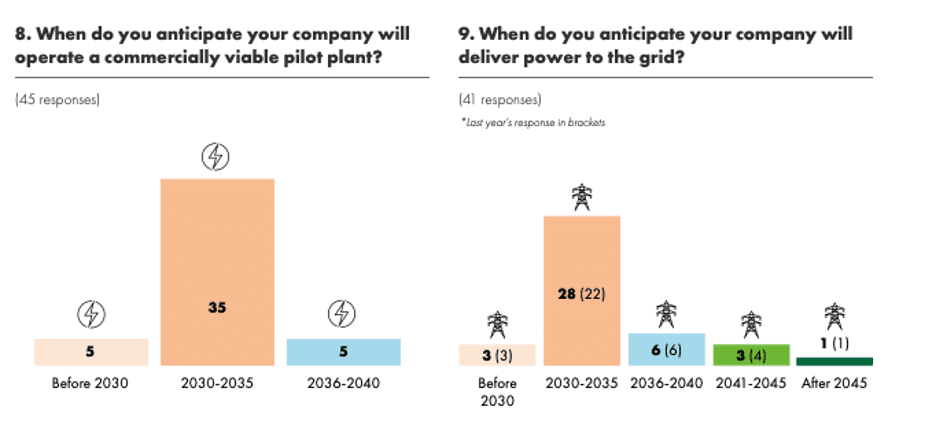
As of October 2025, fusion reactors remain pre-commercial, with no system yet producing net energy. Fusion energy stakeholders provide varying timelines as to when fusion energy will become technically feasible as an energy source for the electrical grid and when it will become commercially viable.  Projections range from 10 years to several decades in the future. [18]   Some companies are claiming that they will achieve commercial fusion energy in the next few years[19] while other stakeholders and experts said fusion energy will take more than 20 years. The Fusion Industry Association reported that many commercial companies predict fusion industry will be commercially viable in the 2030’s time frame. [19] 

Source: The Global Fusion Industry in 2025—Fusion Industry Association

Other stakeholders and experts believe fusion energy might put electricity on the grid in 10 to 20 years, however, significant resources are required to do so.[20] The Figure below illustrates commercialization risks that fusion energy will face on the road to commercial deployment. According to the U.S. Department of Energy, the aspirational timeline as shown is strongly dependent on the level of both public and private investments. [21]

Commercialization risks for fusion

Source. U.S. Department of Energy, Fusion Energy Strategy 2024

Download the Dawnbreaker® OTA Report

Click below to download a copy of the Dawnbreaker® OTA Report. 

DoD Transition Information Packet (TIP)®

The Transition Information Packet (TIP) is a market research report specifically developed for small businesses working with the Department of Defense.

Customized Market Research (CMR)®

Filling in the gaps in your commercialization strategy….

The CMR provides our team with the greatest flexibility in addressing gaps in the information you need to refine your commercialization strategy. Based strictly on secondary literature, the market researcher can look for information that will help you understand changes in government regulations, market dynamics, emerging solutions, sources of funding, points of contact and other challenges you pose. Based on the information gathered, a business strategist will add comments throughout regarding the implications of the information for your strategy.

LICA Licensee Analysis®

Who will take the best care of your baby?

You’ve done a great job with your R&D. You’ve been careful to protect your intellectual property – but those next steps to bring the product to market seem out of reach. There’s too much competition, scale up would be too expensive – so you’ve decided to license-out your intellectual property. The challenge before you is to find the best licensee to bring your baby to market. Let us help you. We will profile organizations that frequently cite your patents and dig deeper to determine their financial health, technology and market synergies, and experience with licensing-in.

Commercial Potential Assessment (CPA)

Be wary of big numbers!

You’ve done a great job with your R&D. You’ve been careful to protect your intellectual property – but those next steps to bring the product to market seem out of reach. There’s too much competition, scale up would be too expensive – so you’ve decided to license-out your intellectual property. The challenge before you is to find the best licensee to bring your baby to market. Let us help you. We will profile organizations that frequently cite your patents and dig deeper to determine their financial health, technology and market synergies, and experience with licensing-in.

Competitor Analysis

Your customers know your competitors! Do you?

Maybe you believe that you don’t have any competition, but your customers know better! Their needs are being addressed now – perhaps not as well, but if there is a need, someone is providing a solution. Learn about the competition and be prepared to differentiate your solution from that of others. Dawnbreaker’s competitor analysis contrasts your competition on specifications, performance and price. Armed with this information we can help you create a compelling value proposition.

Developing Network Contacts (DevNC)

When you need to reach out...

There are times when you need to reach out to others – whether you are looking for potential customers, potential partners, or potential investors. But who should you call…and how do you address your fear of contacting them. The DevNC is a unique market research tool designed to provide you with between 25 and 30 Points of Contact (PoC). With each POC, information is included that provides insight about the person’s role. Depending on their position, other information commonly included relates to their background, articles that they have written, conference presentations and other pertinent information. This type of information enables you to customize your correspondence. Contact information is also included  – typically LinkedIn, email and phone number.

We are in the process of updating the Energy Portal

Please check back soon for access to our updated Energy Portal.