Why SBIR/STTR should be reauthorized NOW

By Jenny C. Servo, Ph.D.

Small, advanced technology firms have suffered enough! What they don’t need now is a death blow from the federal government. During COVID these firms weathered delays in their research due to supply chain issues and illness in their staff. Today, many contend with the loss of employees to large enterprises that view firms funded by the Small Business Innovation Research (SBIR) and Small Business Technology Transfer (STTR) programs as ripe for harvesting qualified, experienced staff. Now is NOT the time to orchestrate the demise of these programs and put at risk the survival of the companies nurtured by participating agencies. Delays in reauthorization of the SBIR/STTR programs and the uncertainty regarding funding will severely damage this vital sector of the U.S. economy.

Let me address some misinformation that is being bantered around.

Some maintain that potential, new entrants to the SBIR/STTR programs fail to secure awards because these are gobbled up first by frequent award winners. Indeed, the threshold for winning an SBIR/STTR award is intentionally high. After all, funding for these programs comes from each participating agency’s extramural R&D budget. Solicitation topics vary widely and are directed at each agency’s mission. Awards are made with taxpayer money and those responsible for making award decisions critically evaluate each proposals’ goodness of fit with the solicitation topic, as well as the ability of the proposed team to conduct the research. Because the threshold is high, new entrants to these programs often need support in preparing their first SBIR/STTR applications. Agencies such as the Department of Energy and the National Institutes of Health have therefore instituted a Phase 0 program to assist new applicants in proposal preparation. The results indicate that such programs have a positive impact on assisting new applicants to win SBIR/STTR awards.

Then there’s the “elephant in the room.” Is money being wasted by giving multiple SBIR/STTR awards to frequent award winners? All different types of companies apply for SBIR/STTR awards. There are start-ups with one or two employees. There are small businesses that have between 10-15 employees who have just heard about these programs for the first time. There are companies that have been around since the 1980’s which have applied to the SBIR/STTR program since that time and have less than 500 employees (threshold for small business). All of these companies win SBIR/STTR awards. However, the infrastructure of each of these firms differs greatly. A start-up with one or two employees is not going to have a laboratory, or the facilities to engage in low-rate production.  True start-ups don’t have differentiated departments and lack considerable business expertise. There are a myriad government programs, many funded through the Small Business Administration designed to assist such companies to develop their infrastructure. The SBIR/STTR programs are for R&D and although it will pay some of a company’s overhead, the small business has to find its own way to secure funding for business growth from other sources. In response some companies seek equity investment, while others pursue other government contracting vehicles and do whatever they can to grow their business engine.

Some of the agencies that participate in the SBIR/STTR programs are actual customers for the technologies that the SBIR/STTR awardees develop. They need the small businesses to be capable of delivering what they are contracted to develop. This leads contracting agencies such as the Department of Defense to focus on the ability of the company to deliver the technology/ solution/product that it is funding in an expeditious manner. By comparison, granting agencies such as the National Science Foundation, the National Institutes of Health and the United States Department of Agriculture are NOT customers for the R&D that they fund. The mission and the criticality of what is being produced are different in contracting and granting agencies. The SBIR/STTR programs are dynamic and appropriately vary in implementation at the agency level.

Commercialization success comes in all shapes and sizes – some are small successes, while others are large and have tremendous impact. It is short-sighted of those who sit in judgment of the SBIR/STTR programs to expect and mention only large commercialization successes. This is after all “seed funding” – the earliest stage of funding, often avoided by venture capital, and a niche which the SBIR/STTR programs have uniquely filled. All commercialization successes should be tracked, celebrated, and publicized. However, there is often insufficient funding for the SBIR/STTR program offices to employ the staff to make this a priority. The successes that truly exist, large and small are under-counted and need to be tracked over an extended period.

Procurement by the federal government of SBIR/STTR funded technologies through the Phase III award mechanism remains a gap. The FY20 NDAA Sec 880 added language to the Small Business Act (15 USC 638) which indicates that Senior Procurement Executives, Procurement Center Representatives (PCR) and Directors of the Office of Small and Disadvantaged Business Utilization (OSDBU) should, “consult with appropriate personnel from the relevant Federal agency to assist SBCs participating in a SBIR or STTR program particularly in Phase III…” However, how to do that remains unclear.

It is important to the U.S. economy that support continues, without interruption for advanced technology firms providing needed R&D solutions through the Small Business Innovation Research and Small Business Technology Transfer programs. It has taken decades to grow and mature these programs. As we emerge from the struggles which everyone had endured with COVID, this fragile and valuable program could be destroyed with a single blow. Re-authorize the SBIR/STTR programs by whatever means possible. Small business innovation depends on it!

Jenny C. Servo, Ph.D. is the President and Founder of Dawnbreaker, a woman-owned small business located in Rochester, NY which has provided commercialization assistance to SBIR/STTR awardees since 1990.
Email
Twitter
LinkedIn

Stay in the Know with Dawnbreaker®

Receive valuable industry insights such as our Market Snapshots, SBIR/STTR & TABA updates, & webinar announcements.

Fusion Energy Overview

Fusion is a potential energy source and occurs when one or more lighter elements combine to form a heavier element, releasing energy in the process. [1] Devices designed to harness this energy are known as fusion reactors. [2]   A future fusion plant could use the heat produced by the fusion reaction to produce steam to drive turbines or generators that produce electricity. [3] For almost a century, scientists around the globe have been looking to recreate and harness the power of fusion energy. [4]  

Tokamak
Source: ITER

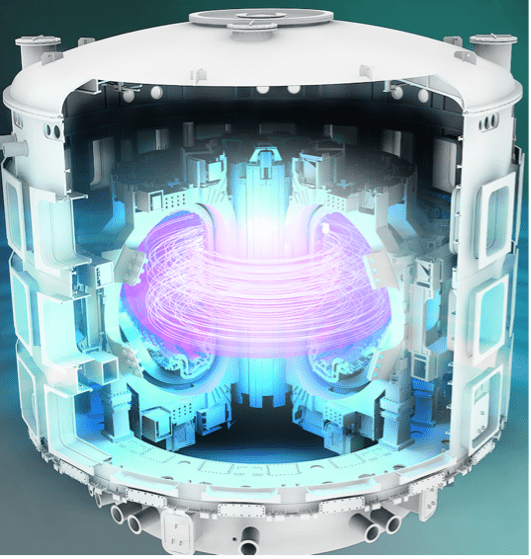
There are two commonly pursued technologies to create and control plasma. Magnetic confinement uses strong magnets to contain plasma. A widely used configuration known as a tokamak[5] uses powerful magnets to confine the plasma within a toroidal reaction vessel, with the magnetic fields keeping the plasma away from the walls of the vessel to prevent damage and unintended cooling of the plasma.[6]  

Examples of U.S. companies developing magnetic confinement systems are Commonwealth Fusion Systems, TAE Technologies, Tokamak Energy, Helion Energy, and Thea Energy. Inertial confinement uses high-power lasers or electrical discharges to compress a small capsule of fusion fuel to extreme temperatures and pressures for a short time. This approach is used, for example, in the National Ignition Facility at the U.S. Department of Energy (DOE) Lawrence Livermore National Laboratory. [7] Examples of U.S. companies developing inertial confinement systems are Xcimer Energy, Focused Energy, ZAP Energy, and Shine Technologies. In addition to these methods, several companies such as General Fusion,  are pursuing various other pathways to try to create and control fusion reactions, including a hybrid of both magnetic and inertial confinement approaches. [8]

Various fusion fuels are used to power these pursued pathways. According to the U.S. Department of Energy, once developed, first-generation fusion plants may likely use a combination of abundant deuterium and lithium as fuel. [9] Deuterium, lithium and tritium Deuterium-tritium is a highly studied fusion fuel and a likely basis for the first fusion power plants.[10] Lithium is a critical resource for fusion because of its material properties. Lithium is used to breed tritium, the key fuel for fusion. [11] The rare lithium-6 form of the metal, which makes up only 7.5 per cent of all naturally occurring lithium, is the most efficient for sustaining the fusion process. [12] Li-6 is banned in the U.S. because of the harmful mercury waste it generates. [13] So most fusion power concepts rely on “enriched” lithium, where the Li-6 content has been boosted. [14]

Several companies are investing in efforts aimed at commercializing fusion energy. [15] Many of these companies are startups that have raised over $100 million in the past few years. [16]  The global fusion energy market size is projected to reach $611.8 billion by 2034, expanding at a CAGR of 5.56% from 2025 to 2034. [17] 

Current State - Projections of the time to putting Fusion Energy on the Grid

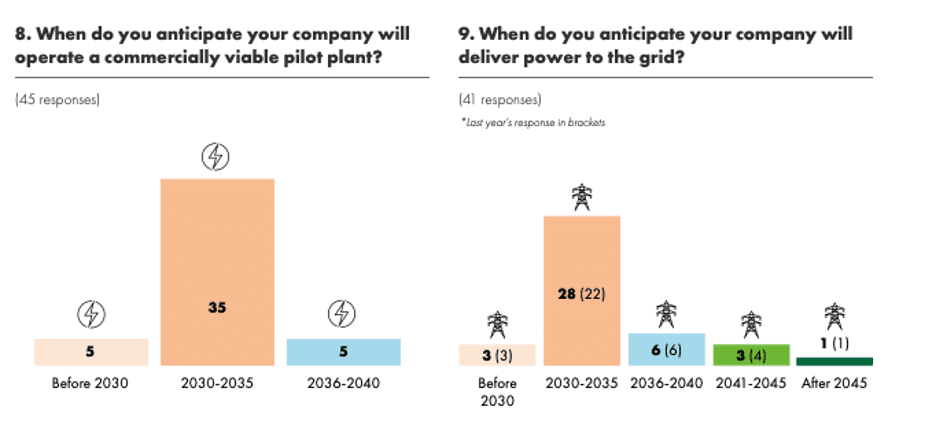
As of October 2025, fusion reactors remain pre-commercial, with no system yet producing net energy. Fusion energy stakeholders provide varying timelines as to when fusion energy will become technically feasible as an energy source for the electrical grid and when it will become commercially viable.  Projections range from 10 years to several decades in the future. [18]   Some companies are claiming that they will achieve commercial fusion energy in the next few years[19] while other stakeholders and experts said fusion energy will take more than 20 years. The Fusion Industry Association reported that many commercial companies predict fusion industry will be commercially viable in the 2030’s time frame. [19] 

Source: The Global Fusion Industry in 2025—Fusion Industry Association

Other stakeholders and experts believe fusion energy might put electricity on the grid in 10 to 20 years, however, significant resources are required to do so.[20] The Figure below illustrates commercialization risks that fusion energy will face on the road to commercial deployment. According to the U.S. Department of Energy, the aspirational timeline as shown is strongly dependent on the level of both public and private investments. [21]

Commercialization risks for fusion

Source. U.S. Department of Energy, Fusion Energy Strategy 2024

Download the Dawnbreaker® OTA Report

Click below to download a copy of the Dawnbreaker® OTA Report. 

DoD Transition Information Packet (TIP)®

The Transition Information Packet (TIP) is a market research report specifically developed for small businesses working with the Department of Defense.

Customized Market Research (CMR)®

Filling in the gaps in your commercialization strategy….

The CMR provides our team with the greatest flexibility in addressing gaps in the information you need to refine your commercialization strategy. Based strictly on secondary literature, the market researcher can look for information that will help you understand changes in government regulations, market dynamics, emerging solutions, sources of funding, points of contact and other challenges you pose. Based on the information gathered, a business strategist will add comments throughout regarding the implications of the information for your strategy.

LICA Licensee Analysis®

Who will take the best care of your baby?

You’ve done a great job with your R&D. You’ve been careful to protect your intellectual property – but those next steps to bring the product to market seem out of reach. There’s too much competition, scale up would be too expensive – so you’ve decided to license-out your intellectual property. The challenge before you is to find the best licensee to bring your baby to market. Let us help you. We will profile organizations that frequently cite your patents and dig deeper to determine their financial health, technology and market synergies, and experience with licensing-in.

Commercial Potential Assessment (CPA)

Be wary of big numbers!

You’ve done a great job with your R&D. You’ve been careful to protect your intellectual property – but those next steps to bring the product to market seem out of reach. There’s too much competition, scale up would be too expensive – so you’ve decided to license-out your intellectual property. The challenge before you is to find the best licensee to bring your baby to market. Let us help you. We will profile organizations that frequently cite your patents and dig deeper to determine their financial health, technology and market synergies, and experience with licensing-in.

Competitor Analysis

Your customers know your competitors! Do you?

Maybe you believe that you don’t have any competition, but your customers know better! Their needs are being addressed now – perhaps not as well, but if there is a need, someone is providing a solution. Learn about the competition and be prepared to differentiate your solution from that of others. Dawnbreaker’s competitor analysis contrasts your competition on specifications, performance and price. Armed with this information we can help you create a compelling value proposition.

Developing Network Contacts (DevNC)

When you need to reach out...

There are times when you need to reach out to others – whether you are looking for potential customers, potential partners, or potential investors. But who should you call…and how do you address your fear of contacting them. The DevNC is a unique market research tool designed to provide you with between 25 and 30 Points of Contact (PoC). With each POC, information is included that provides insight about the person’s role. Depending on their position, other information commonly included relates to their background, articles that they have written, conference presentations and other pertinent information. This type of information enables you to customize your correspondence. Contact information is also included  – typically LinkedIn, email and phone number.

We are in the process of updating the Energy Portal

Please check back soon for access to our updated Energy Portal.