Market Snapshot: Small Modular Reactors

Small modular reactors (SMRs) are an integral part of the Department of Energy’s goal to “develop safe, clean, and affordable nuclear power options.” SMRs are nuclear fission reactors with a power capacity of up to 300 MW(e) per unit, approximately one-third of the generating capacity of traditional nuclear power reactors. Modular designs allow components to be assembled in a factory and add more modules as required. SMRs can be deployed for various applications like power generation, process heat, desalination or other industrial applications. SMRs could also help with the demanding energy needs of data centers. The various types of SMRs include heavy water and light water reactors, high-temperature reactors, fast neutron reactors, and molten salt reactors.

SMRs are an emerging market with numerous designs currently under development. In a July 2025 report, the Nuclear Energy Agency (NEA) identified 127 global SMR technologies (74 with publicly accessible information, 25 under development but which requested not to be included, and 28 not under active development). Of the 74 SMR designs under development, 30 designs are being pursued by 25 design organizations headquartered in North America. NEA also cited additional benefits of SMRs including using significantly less water than large reactors and a lower requirement for critical minerals.

The World Nuclear Association states there are two SMRs currently operational: Russia’s KLT-40S pressurized water reactor (PWR) and China’s high-temperature gas-cooled modular pebble bed (HTR-PM) reactor demonstrator. The KLT-40S began commercial operation in May 2020. It is owned and operated by Joint Stock Company ‘Concern Rosenergoatom.’ China’s HTR-PM began commercial operation in December 2023. It is owned by China Huaneng Group and operated by Huaneng Shandong Shidao Bay Nuclear Power Company, Ltd.

In 2020, the U.S. Nuclear Regulatory Commission (NRC) approved the first SMR design in the U.S., which was submitted by NuScale Power (NYSE: SMR) based in Corvallis, OR. In May 2025, NRC approved NuScale Power’s uprated power module–the company’s second SMR design. Other U.S. SMR companies that are publicly traded include BWX Technologies (NYSE: BWXT) in Lynchburg, Virginia and Oklo Inc. (NYSE: OKLO) from Santa Clara, California. Some of the major SMR developers in North America expected to commercialize SMRs in the near future are NuScale Power, LLC. (U.S.), GE Hitachi Nuclear Energy (U.S.), Moltex Energy (Canada), and Terrestrial Energy Inc. (U.S. & Canada), according to MarketsandMarkets.

Upcoming events of interest include MiNES 2025 and SMR, AMS Winter 2025, and Advanced Reactor 2026. Materials in Nuclear Energy Systems 2025 (MiNES 2025) in Cleveland, Ohio December 7-11, 2025. Conference organizers are affiliated with several national labs, universities, and industry leaders. The 2025 ANS Winter Conference & Expo will be held in Washington, DC November 9-12, 2025. This event includes executive sessions to unpack the latest executive orders and attended by senior officials from the administration and Congress. The SMR & Advanced Reactor 2026  will be held in Austin, Texas in May 2026. This senior-level meeting for the SMR community will bring together over 750 leaders from utilities, financiers, reactor developers, technology providers and regulators.

If you found this helpful and would like more information, please contact Lyn Barnett.

Want to be notified of more Market Snapshots like this? Use the form to subscribe!

For all other questions and more information, please contact Lyn Barnett by emailing lbarnett@dawnbreaker.com
* indicates required
Website Sign-ups

Share this article:

Email
X
LinkedIn

Click below to learn about our market research services

Stay in the Know with Dawnbreaker®

Receive valuable industry insights such as our Market Snapshots, SBIR/STTR & TABA updates, & webinar announcements.

Fusion Energy Overview

Fusion is a potential energy source and occurs when one or more lighter elements combine to form a heavier element, releasing energy in the process. [1] Devices designed to harness this energy are known as fusion reactors. [2]   A future fusion plant could use the heat produced by the fusion reaction to produce steam to drive turbines or generators that produce electricity. [3] For almost a century, scientists around the globe have been looking to recreate and harness the power of fusion energy. [4]  

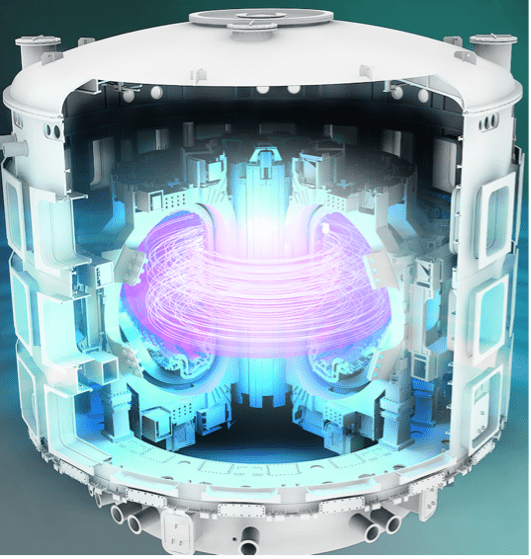
Tokamak
Source: ITER

There are two commonly pursued technologies to create and control plasma. Magnetic confinement uses strong magnets to contain plasma. A widely used configuration known as a tokamak[5] uses powerful magnets to confine the plasma within a toroidal reaction vessel, with the magnetic fields keeping the plasma away from the walls of the vessel to prevent damage and unintended cooling of the plasma.[6]  

Examples of U.S. companies developing magnetic confinement systems are Commonwealth Fusion Systems, TAE Technologies, Tokamak Energy, Helion Energy, and Thea Energy. Inertial confinement uses high-power lasers or electrical discharges to compress a small capsule of fusion fuel to extreme temperatures and pressures for a short time. This approach is used, for example, in the National Ignition Facility at the U.S. Department of Energy (DOE) Lawrence Livermore National Laboratory. [7] Examples of U.S. companies developing inertial confinement systems are Xcimer Energy, Focused Energy, ZAP Energy, and Shine Technologies. In addition to these methods, several companies such as General Fusion,  are pursuing various other pathways to try to create and control fusion reactions, including a hybrid of both magnetic and inertial confinement approaches. [8]

Various fusion fuels are used to power these pursued pathways. According to the U.S. Department of Energy, once developed, first-generation fusion plants may likely use a combination of abundant deuterium and lithium as fuel. [9] Deuterium, lithium and tritium Deuterium-tritium is a highly studied fusion fuel and a likely basis for the first fusion power plants.[10] Lithium is a critical resource for fusion because of its material properties. Lithium is used to breed tritium, the key fuel for fusion. [11] The rare lithium-6 form of the metal, which makes up only 7.5 per cent of all naturally occurring lithium, is the most efficient for sustaining the fusion process. [12] Li-6 is banned in the U.S. because of the harmful mercury waste it generates. [13] So most fusion power concepts rely on “enriched” lithium, where the Li-6 content has been boosted. [14]

Several companies are investing in efforts aimed at commercializing fusion energy. [15] Many of these companies are startups that have raised over $100 million in the past few years. [16]  The global fusion energy market size is projected to reach $611.8 billion by 2034, expanding at a CAGR of 5.56% from 2025 to 2034. [17] 

Current State - Projections of the time to putting Fusion Energy on the Grid

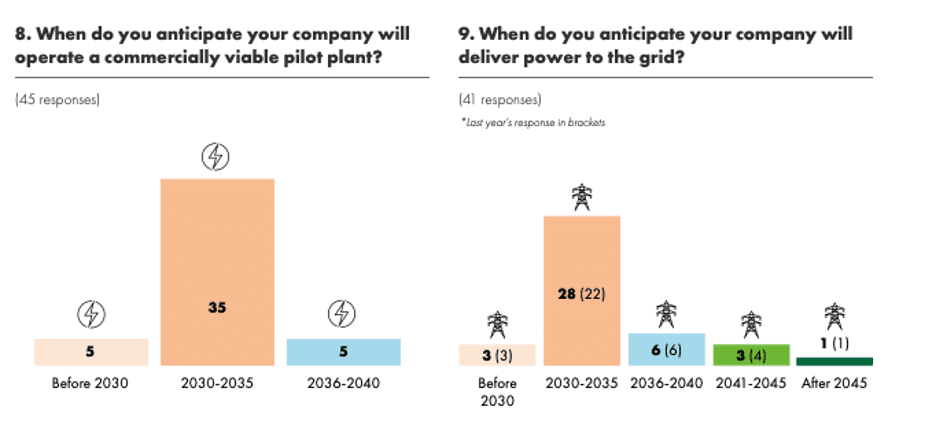
As of October 2025, fusion reactors remain pre-commercial, with no system yet producing net energy. Fusion energy stakeholders provide varying timelines as to when fusion energy will become technically feasible as an energy source for the electrical grid and when it will become commercially viable.  Projections range from 10 years to several decades in the future. [18]   Some companies are claiming that they will achieve commercial fusion energy in the next few years[19] while other stakeholders and experts said fusion energy will take more than 20 years. The Fusion Industry Association reported that many commercial companies predict fusion industry will be commercially viable in the 2030’s time frame. [19] 

Source: The Global Fusion Industry in 2025—Fusion Industry Association

Other stakeholders and experts believe fusion energy might put electricity on the grid in 10 to 20 years, however, significant resources are required to do so.[20] The Figure below illustrates commercialization risks that fusion energy will face on the road to commercial deployment. According to the U.S. Department of Energy, the aspirational timeline as shown is strongly dependent on the level of both public and private investments. [21]

Commercialization risks for fusion

Source. U.S. Department of Energy, Fusion Energy Strategy 2024

Download the Dawnbreaker® OTA Report

Click below to download a copy of the Dawnbreaker® OTA Report. 

DoD Transition Information Packet (TIP)®

The Transition Information Packet (TIP) is a market research report specifically developed for small businesses working with the Department of Defense.

Customized Market Research (CMR)®

Filling in the gaps in your commercialization strategy….

The CMR provides our team with the greatest flexibility in addressing gaps in the information you need to refine your commercialization strategy. Based strictly on secondary literature, the market researcher can look for information that will help you understand changes in government regulations, market dynamics, emerging solutions, sources of funding, points of contact and other challenges you pose. Based on the information gathered, a business strategist will add comments throughout regarding the implications of the information for your strategy.

LICA Licensee Analysis®

Who will take the best care of your baby?

You’ve done a great job with your R&D. You’ve been careful to protect your intellectual property – but those next steps to bring the product to market seem out of reach. There’s too much competition, scale up would be too expensive – so you’ve decided to license-out your intellectual property. The challenge before you is to find the best licensee to bring your baby to market. Let us help you. We will profile organizations that frequently cite your patents and dig deeper to determine their financial health, technology and market synergies, and experience with licensing-in.

Commercial Potential Assessment (CPA)

Be wary of big numbers!

You’ve done a great job with your R&D. You’ve been careful to protect your intellectual property – but those next steps to bring the product to market seem out of reach. There’s too much competition, scale up would be too expensive – so you’ve decided to license-out your intellectual property. The challenge before you is to find the best licensee to bring your baby to market. Let us help you. We will profile organizations that frequently cite your patents and dig deeper to determine their financial health, technology and market synergies, and experience with licensing-in.

Competitor Analysis

Your customers know your competitors! Do you?

Maybe you believe that you don’t have any competition, but your customers know better! Their needs are being addressed now – perhaps not as well, but if there is a need, someone is providing a solution. Learn about the competition and be prepared to differentiate your solution from that of others. Dawnbreaker’s competitor analysis contrasts your competition on specifications, performance and price. Armed with this information we can help you create a compelling value proposition.

Developing Network Contacts (DevNC)

When you need to reach out...

There are times when you need to reach out to others – whether you are looking for potential customers, potential partners, or potential investors. But who should you call…and how do you address your fear of contacting them. The DevNC is a unique market research tool designed to provide you with between 25 and 30 Points of Contact (PoC). With each POC, information is included that provides insight about the person’s role. Depending on their position, other information commonly included relates to their background, articles that they have written, conference presentations and other pertinent information. This type of information enables you to customize your correspondence. Contact information is also included  – typically LinkedIn, email and phone number.

We are in the process of updating the Energy Portal

Please check back soon for access to our updated Energy Portal.