Nuclear Energy
Nuclear energy is created at an atomic level, when energy is released from the nucleus (protons and neutrons) either by fission or fusion.
- Overview
- Technologies
- Technology Gaps
- Roadmaps
- Conferences
Nuclear Energy Overview
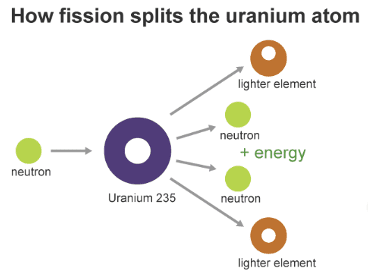
Nuclear energy is the energy in the nucleus of an atom—it is the energy that holds neutrons and protons. Nuclear energy can be used to produce electricity. This energy can be obtained in two ways: nuclear fusion and nuclear fission. In nuclear fusion, energy is released when atoms are combined (or fused together) to form a larger atom. Nuclear fission is when atoms are split apart, releasing energy. [1]
Energy from nuclear plants is rising, producing just under 10% of global generation. Nuclear energy generation is the second-largest source of low-emissions electricity today, after hydropower. As of 2023, IEA reported nearly 420 active nuclear reactors globally. [2] There are currently about 63 nuclear reactors under construction with more than 70 gigawatts (GW) of capacity. Plus, a new multi-country initiative aims to triple global nuclear capacity by 2050. [3]
In the United States, there were 54 commercially operating nuclear power plants, as of April 30, 2024, comprised of 94 nuclear power reactors in 28 states. Illinois has the highest number with 11 reactors capable of generating 12% of total U.S. operating nuclear electricity generation capacity. [4] The oldest operating reactor is Nine Mile Point Unit 1 in New York State, which entered commercial service in December 1969. The newest reactor to enter service is Vogtle Unit 4 at the Alvin W. Vogtle Electric Generating Plant in Georgia that began commercial operation on April 29, 2024. [5]
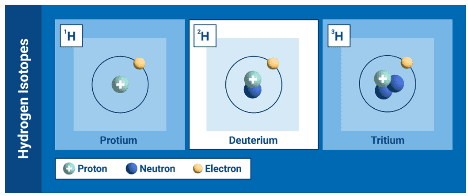
Nuclear fission typically uses uranium as the fuel source, specifically uranium (U-235) because its atoms are easily split apart. However, U-235 is relatively rare, at just over 0.7% of natural uranium. [6] In contrast, most fusion reactor concepts currently under development use a plentiful and easily accessible fuel source: a mixture of deuterium and tritium (hydrogen isotopes that contain extra neutrons). Deuterium can be extracted inexpensively from seawater, and tritium can potentially be produced from the reaction of fusion generated neutrons with naturally abundant lithium. [7]
Source: IAEA, 2023
Another path to encourage nuclear energy is the construction of cost-competitive small modular reactors (SMRs). [3] According to the U.S. Department of Energy, “Small modular reactors offer a lower initial capital investment, greater scalability, and siting flexibility for locations unable to accommodate more traditional larger reactors.” [8] In 2020, NRC approved the first SMR design in the U.S., which was submitted by NuScale Power. Some of the major SMR developers in North America expected to commercialize SMRs in the near future are are NuScale Power, LLC. (US), GE Hitachi Nuclear Energy (US), Moltex Energy (Canada), and Terrestrial Energy Inc. (Canada). [9]
Technologies
What Technologies are currently in place for nuclear power?
Over the past two decades, nuclear power has contributed almost 20% of electrical generation in the United States, according to the U.S. Department of Energy (DOE). Nuclear power is the single largest contributor (more than 70%) of non-greenhouse-gas-emitting electric power generation in the United States.
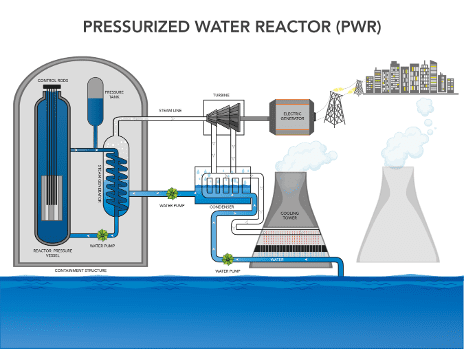
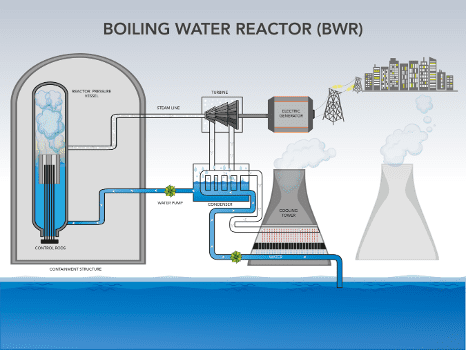
All commercial nuclear reactors in the U.S. are light-water reactors, meaning they use normal water as both a coolant and neutron moderator. There are two types of light-water reactors operating in the USA: Pressurized Water Reactors (PWR) and Boiling Water Reactors (BWR). According to the U.S. Nuclear Regulatory Commission (NRC), “there are currently 95 licensed to operate nuclear power plants in the United States (64 PWRs and 31 BWRs).”
PWR vs BWR
Over 65% of the U.S. commercial reactors are PWRs, which pump water into the reactor core under high pressure to prevent the water from boiling. Nuclear fission is used to heat water in the core that’s then pumped into tubes where it’s heated again to create steam. The steam turns an electric generator, producing electricity. The process is repeated after the core water cycles back to the reactor to be reheated.
The remaining third of the U.S. nuclear reactors in operation are BWRs, which means the reactor heats water by fission to produce steam inside the reactor vessel. The steam travels through pipes directly to a turbine to produce electricity. Unused steam is condensed back to water and then reused in the heating process.
Need for Modernization
The Yankee Rowe, designed by Westinghouse, was the first fully commercial pressurized water reactor (PWR), beginning operations in 1960 until 1992. Almost all the U.S. nuclear generating capacity comes from reactors built between 1967 and 1990. The average age of U.S. nuclear plants is over 40 years. Until 2013, the newest construction occurred in 1977. Georgia Power’s Plant Vogtle units 3 and 4 are “the first newly constructed nuclear units built in the United States in more than three decades.” In July 2023, Vogtle 3 entered commercial operation, followed by unit 4 in April 2024.
DOE’s Light Water Reactor Sustainability (LWRS) program seeks to improve reliability, safety, and extend the operation of the nation’s fleet of nuclear power plants. The key R&D areas to address the fleet needs consist of the following technical areas: plant modernization, flexible plant operation and generation, risk-informed analysis, materials research, and physical security.
In May 2025, President Donald Trump signed a series of executive orders with the goal of “re-establishing the United States as the global leader in nuclear energy.” The orders lay out a plan to modernize nuclear regulation, streamline nuclear reactor testing, deploy nuclear reactors for national security, and reinvigorate the nuclear industrial base. One specific goal is to add 300 GW of nuclear energy capacity by 2050, increasing it from 100 GW to 400 GW.
Advanced Reactor Concepts
The Office of Advanced Reactor Technologies (ART) sponsors research, development and deployment (RD&D) focused on advancing innovative Generation IV nuclear energy technologies. The Office of Nuclear Energy will pursue these advancements through RD&D activities at DOE national laboratories and U.S. universities to pursue technological advancements related to nuclear energy. This involves initiatives through its Next Generation Nuclear Plant (NGNP), Advanced Reactor Concepts (ARC), and Advanced Small Modular Reactor (ASMR) programs.
The ARC program’s research of advanced reactor subsystems addresses long-term technical barriers for the development of advanced nuclear fission energy systems utilizing coolants such as liquid metal, fluoride salt, or gas. The advanced reactor concepts include liquid metal fast reactor, molten salt reactor, high-temperature gas reactor, advanced light-water reactor, and heat pipe reactor.
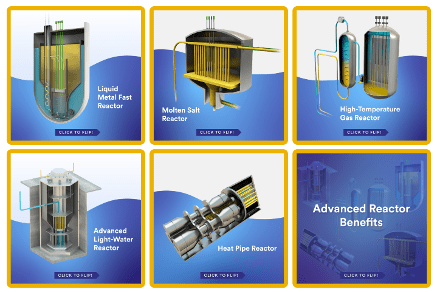
Source: DOE, 2025
Small Modular Reactors (SMRs)
Small modular reactors (SMRs) are an integral part of DOE’s goal to “develop safe, clean, and affordable nuclear power options.” SMRs are nuclear fission reactors with a power capacity of up to 300 MW(e) per unit, approximately one-third of the generating capacity of traditional nuclear power reactors. Modular designs allow components to be assembled in a factory and add more modules as required. SMRs can be deployed for various applications like power generation, process heat, desalination or other industrial applications. The various types of SMRs include heavy water and light water reactors, high-temperature reactors, fast neutron reactors, and molten salt reactors. In 2020, the U.S. Nuclear Regulatory Commission (NRC) approved the first SMR design in the U.S., which was submitted by NuScale Power.
For information on the storage and disposal of radioactive waste, see the World Nuclear Association.
Technology Gaps
- Replacement of legacy instrumentation and control (I&C) technologies
- Uranium production
- Innovative fuels, new materials and designs for cladding and fuel pellets
- Predicting the performance of materials in nuclear power plants
- Advanced modeling and simulation tools for physical security scenarios
- Develop and demonstrate coupling of an advanced reactor with a non-electric application
- Advancing the design, certification and demonstration of SMRs for both electric and non-electric applications
- Close the nuclear fuel cycle loop by multi-recycling nuclear materials
- Reactor technologies using other coolants (e.g. helium, sodium or molten salts)
- R&D and prototype development for Gen IV systems to ensure technologies are ready for deployment in 2030‑2040
- New reprocessing technologies deployed in conjunction with fast neutron reactors
- Securing resilient supply chains
- Workforce education and training
Roadmaps and Resources
This page provides links to recent industry roadmaps and publications related to nuclear energy technologies.
Roadmaps to New Nuclear 2024 (NEA)
The Nuclear Energy Agency (NEA) published the Roadmaps to New Nuclear 2024 Brief for Ministers and CEOs with the goal of strengthening capacities for successful nuclear energy new build projects. The Brief outlines how governments and industry can foster international collaboration, support strategic partnerships, and share best practices. The roadmap covers topics like financing nuclear energy projects, supply chain readiness, and developing a talent pipeline.
NEA Annual Report 2024
The Nuclear Energy Agency (NEA) Annual Report provides an overview of the agency’s activities and publications produced during the year, as well as the latest global developments in nuclear energy sector. The report covers various topics, including nuclear development, nuclear safety and regulation, radiological protection, radioactive waste management, decommissioning of nuclear installations, nuclear science and education, and nuclear law. The 2024 NEA Annual Report provides reliable information and analyses on current and future nuclear technologies for governments and other relevant stakeholders.
Nuclear Technology Review 2024 (IAEA)
The International Energy Agency’s (IAEA) Nuclear Technology Review 2024 highlights the notable industry changes and developments in 2023. The report covers the following relevant areas: nuclear power, nuclear fuel cycle, decommissioning, environmental remediation and radioactive waste management, fusion research and technology development for future energy production, research reactors, particle accelerators and nuclear instrumentation, atomic and nuclear data, artificial intelligence in nuclear power and the nuclear fuel cycle, human health, food and agriculture, radioisotope and radiation technology, isotope hydrology and marine environment.
The Path to a New Era for Nuclear Energy (IAEA)
IAEA’s report The Path to a New Era for Nuclear Energy explores nuclear energy’s potential to tackle energy security, highlighting the need for policies, innovation, and financing.
Advances in SMR Developments 2024 (IAEA)
IAEA’s Small Modular Reactors: Advances in SMR Development provides an overview of global SMR technology developments. It highlights IAEA’s role in supporting sustainable nuclear power programs. The data used is primarily from the 2024 ARIS database.
Nuclear Energy Academic Roadmap 2024 (ORAU)
Oakridge Associated Universities (ORAU) held a series of workshops in May 2024. These workshops discussed critical challenges of the nuclear sector by addressing enhancing career awareness, evaluating financial support to expand academic/training programs, and developing curricula and resources to prepare candidates for the workforce. The roadmap includes recommendations in each of these areas for the following groups: K-12, vocational-technical schools, 2-year academic institutions, 4-year academic institutions, advanced studies, and professional development.
Conferences and upcoming major events in 2025 and 2026
025 DIII-D Industry Event Day
November 14, 2025 – San Diego, California
67th Annual Meeting of the APS Division of Plasma Physics
November 17-21, 2025 – Long Beach, California
16th International Symposium on Fusion Nuclear Technology
November 9-14, 2025 – Knoxville, Tennessee
Fusion Industry Association Annual Policy Conference 2026
March 18-19, 2026 – Washington, DC
https://www.fusionindustryassociation.org/fia-annual-conference-2026/
IFE-STAR 2026 Conference
Washington, D.C. – March 22–27, 2026
2026 Innovative Concepts for Inertial Fusion Energy (IC-IFE)
May 20-22, 2026 – Livermore, California
American Nuclear Society 2026 Annual Conference
May 31–June 3, 2026 – Denver, Colorado
2026 IEEE International Conference on Plasma Science (ICOPS)
June 22 – 26, 2026 0 Lake Tahoe, Nevada
https://conferences.ieee.org/conferences_events/conferences/conferencedetails/53334
The Applied Superconductivity Conference (ASC 2026)
September 6 -11, 2026 – Pittsburgh, Pennsylvania
https://www.appliedsuperconductivity.org/asc2026/
Explore Other Energy Sources
Stay in the Know with Dawnbreaker®
Receive valuable industry insights such as our Market Snapshots, SBIR/STTR & TABA updates, & webinar announcements.