Nuclear Energy
Priorities: Accelerate the development of next generation nuclear technology
- Overview
- Key Challenges
- Knowledge Hub
- Conferences
Nuclear Energy Overview
Energy from nuclear power plants is rising, producing just under 10% of the global electricity supply. Nuclear energy generation is the second-largest source of low-emissions electricity today, after hydropower. As of 2026, World Nuclear Association reported that 31 countries generate electricity from nuclear energy from nearly 440 active power reactors globally. There are currently over 75 nuclear reactors under construction with approximately 120 additional reactors planned. Investments in nuclear energy are on target to increase global nuclear capacity by more than 50% by 2050 to nearly 650 GW.
As of March 2026, in the United States there are 57 commercially operating nuclear power plants, comprised of 96 nuclear power reactors in 28 states. Illinois has the highest number with 11 reactors capable of generating 12% of total U.S. operating nuclear electricity generation capacity. The oldest operating reactor is Nine Mile Point Unit 1 in New York State, which entered commercial service in December 1969. The newest reactor to enter service is Vogtle Unit 4 at the Alvin W. Vogtle Electric Generating Plant in Georgia that began commercial operation on April 29, 2024.
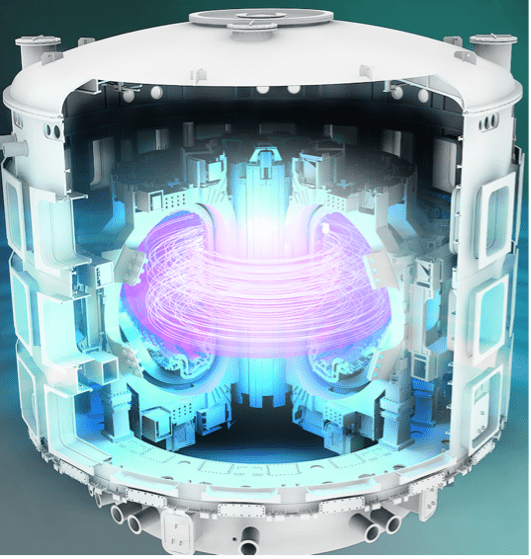
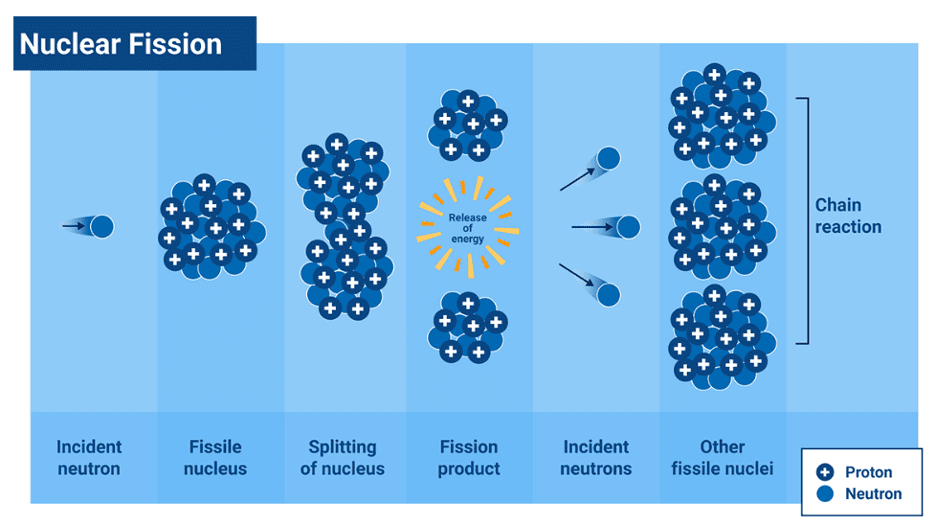
Nuclear fission typically uses uranium as the fuel source, specifically uranium (U-235) because its atoms are easily split apart.
Source: IAEA
What Technologies are currently in place for nuclear power?
Over the past two decades, nuclear power has contributed almost 20% of electrical generation in the United States, according to the U.S. Department of Energy (DOE). Nuclear power is a clean source of electric power generation in the United States.
All commercial nuclear reactors in the U.S. are light-water reactors, meaning they use normal water as both a coolant and neutron moderator. There are two types of light-water reactors operating in the USA: Pressurized Water Reactors (PWR) and Boiling Water Reactors (BWR). According to the U.S. Nuclear Regulatory Commission (NRC), “there are currently 95 licensed to operate nuclear power plants in the United States (64 PWRs and 31 BWRs).”
PWR vs BWR
Pressurized Water Reactor (PWR)
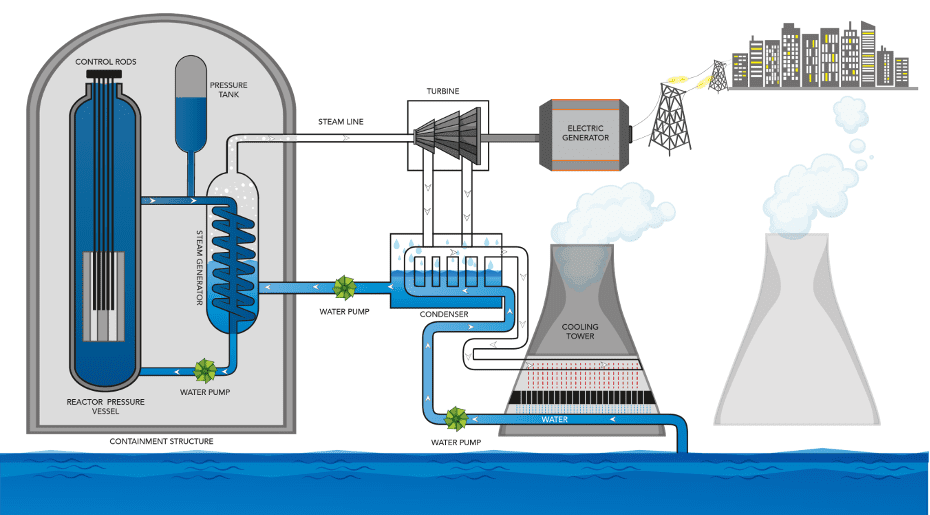
Over 65% of the U.S. commercial reactors are PWRs, which pump water into the reactor core under high pressure to prevent the water from boiling. Nuclear fission is used to heat water in the core that’s then pumped into tubes where it’s heated again to create steam. The steam turns an electric generator, producing electricity. The process is repeated after the core water cycles back to the reactor to be reheated.
Pressurized Water Reactor (PWR)
Source: DOE, 2025
Boiling Water Reactor (BWR)
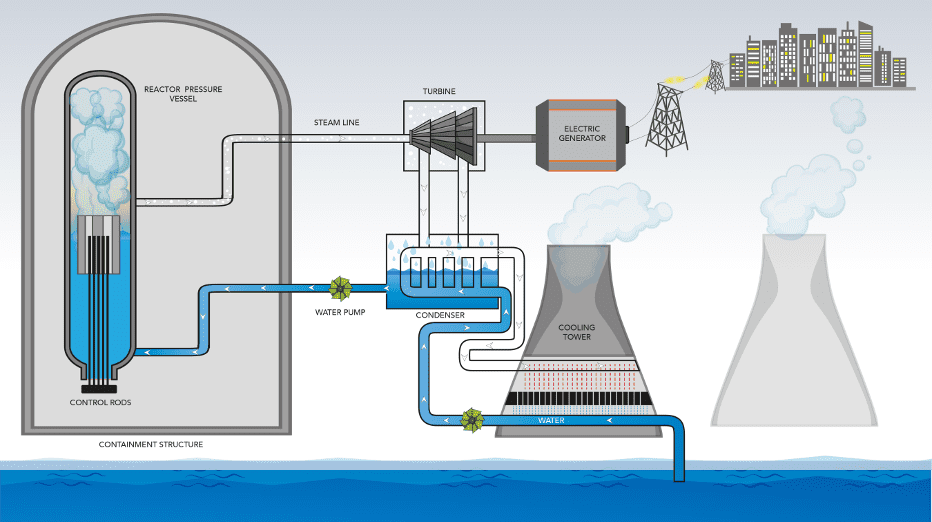
The remaining third of the U.S. nuclear reactors in operation are BWRs, which means the reactor heats water by fission to produce steam inside the reactor vessel. The steam travels through pipes directly to a turbine to produce electricity. Unused steam is condensed back to water and then reused in the heating process.
Boiling Water Reactor (BWR)
Source: DOE, 2025
Small Modular Reactors (SMRs)
Another path to encourage nuclear energy is the construction of cost-competitive small modular reactors (SMRs), which are primed for rapid growth. SMRs are nuclear fission reactors with a power capacity of up to 300 MW(e) per unit, approximately one-third of the generating capacity of traditional nuclear power reactors. Modular designs allow components to be assembled in a factory and add more modules as required. SMRs can be deployed for various applications like power generation, process heat, desalination or other industrial applications. The various types of SMRs include heavy water and light water reactors, high-temperature reactors, fast neutron reactors, and molten salt reactors.
According to the U.S. Department of Energy, “Small modular reactors offer a lower initial capital investment, greater scalability, and siting flexibility for locations unable to accommodate more traditional larger reactors.” Small modular reactors (SMRs) are an integral part of DOE’s goal to “develop safe, clean, and affordable nuclear power options.” In 2020, NRC approved the first SMR design in the U.S., which was submitted by NuScale Power. In May 2026, the U.S. Department of Energy (DOE) selected eight companies “to support the near-term deployment of advanced light-water small modular reactors (SMRs) in the United States” with awards amounting to $94 million.
Market Research by Jennifer Ostromecki
Updated June 24, 2026
Key Challenges
Need for Modernization
The Yankee Rowe, designed by Westinghouse, was the first fully commercial pressurized water reactor (PWR), beginning operations in 1960 until 1992. Dresden 1, designed by General Electric, was the first commercial boiling water reactor (BWR) plant, which began operation in 1960. Currently, almost all U.S. nuclear generating capacity comes from reactors built between 1967 and 1990. The average age of U.S. nuclear plants is over 40 years. Until 2013, the newest construction occurred in 1977. Georgia Power’s Plant Vogtle units 3 and 4 are “the first newly constructed nuclear units built in the United States in more than three decades.” In July 2023, Vogtle 3 entered commercial operation, followed by unit 4 in April 2024.
The U.S. Department of Energy’s (DOE) Light Water Reactor Sustainability (LWRS) program seeks to improve reliability, safety, and extend the operation of the nation’s fleet of nuclear power plants. The key R&D areas to address the fleet needs consist of the following technical areas:
- plant modernization,
- flexible plant operation and generation,
- risk-informed analysis, materials research, and
- physical security.
In May 2025, President Donald Trump signed a series of executive orders with the goal of “re-establishing the United States as the global leader in nuclear energy.” The orders lay out a plan to modernize nuclear regulation, streamline nuclear reactor testing, deploy nuclear reactors for national security, and reinvigorate the nuclear industrial base. One specific goal is to add 300 GW of nuclear energy capacity by 2050, increasing it from 100 GW to 400 GW. One specific goal is driving the need to significantly increase the energy capacity, which is to meet the growing power demands of AI data centers.
In March 2026, DOE launched the UPRISE (Utility Power Reactor Incremental Scaling Effort) program, which seeks to enhance the nation’s nuclear energy production with four goals: increase the power output of existing reactors; bring dormant facilities back online; complete stalled projects; and advance new reactor construction.
High Upfront Costs and Slow Construction
The U.S. construction sector has experienced a decline in productivity since the 1960s. Nuclear power plants are very complex construction projects. Upfront costs for nuclear power plant development encompass expenditures incurred before and during construction, including design, licensing, engineering, equipment, labor, and financing. Pre-construction costs—often underrepresented—can be substantial, particularly regulatory and licensing expenses, with regulator fees around $60 million per reactor per country and licensing costs ranging from approximately $180–240 million per design per country. The construction time is the duration between “the pouring of the first ‘nuclear concrete’ and grid connection.” Long construction periods push up financing costs. The construction of the two most recent reactors in the U.S., finished in 2023 and 2024, took 7 years longer than scheduled and cost around $15,000 for every kilowatt of generating capacity. Meanwhile, the nuclear plants built in the 1970s cost less than $2,000 per kilowatt (adjusted for inflation). The Executive Orders issued seek speedy deployment of nuclear reactors to power artificial intelligence (AI)-focused installations.
Licensing Timeline
Another important push from the Executive Orders has been to impress upon NRC to revise its rules on licensing to accelerate those timelines. One of the challenges NRC has faced is difficulty in hiring and retaining the staff needed to license these nuclear reactors. NRC has reported the following on reactor design certification:
- Six reactor design certifications (DCs) have been issued:
- General Electric-Hitachi Nuclear Energy’s ABWR (Advanced Boiling-Water Reactor)
- Westinghouse Electric Company’s System 80+
- Westinghouse Electric Company’s AP600
- Westinghouse Electric Company’s AP1000
- General Electric-Hitachi Nuclear Energy’s ESBWR (Economic Simplified Boiling-Water Reactor)
- Korean Electric Power Corporation APR 1400 (Advanced Power Reactor)
- One DC application is under review for the NuScale small modular reactor design and has been issued a final safety evaluation report.
- Two DC applications for U.S. EPR (Evolutionary Pressurized-Water Reactor) and US-APWR (Advanced Pressurized-Water Reactor) are suspended at the request of the applicants.
- One DC renewal application is under review for the ABWR design.
Public Awareness
DOE acknowledges that a constraint in advancing nuclear energy is that the general public can sometimes view it as a dangerous or unstable process for two main reasons. First, the public often links nuclear power with the three global nuclear accidents. The second is a misconception that nuclear power is similar to nuclear weapons. While the process does create spent fuel, it is incorrectly referred to as nuclear waste. Commercial nuclear fuel is a solid. To combat these perceptions, DOE and national labs are dedicated to providing fact-based information through STEM outreach and its social media platforms.
Used Fuel Transportation, Storage and Disposal
Most of the country’s spent fuel is stored, safely and securely, at more than 70 reactor locations. Approximately 25% of these sites do not have a reactor in operation. While the public may be apprehensive about the transportation of spent fuel, more than 2,500 cask shipments of spent fuel across the U.S. without any radiological releases to the environment or harm to the public for more than five decades.
However, the lack of a permanent disposal solution contributes to ongoing public unease. DOE is actively evaluating nuclear power plant sites and nearby transportation infrastructure to support transporting spent fuel away from these sites. The facility’s location will be selected through a consent-based siting process that prioritizes community input, ultimately reducing the number of storage locations nationwide. For more information on the myths and realities of radioactive waste, see this recent article by the World Nuclear Association.
Advanced Reactor Concepts
The Office of Advanced Reactor Technologies (ART) sponsors research, development and deployment (RD&D) focused on advancing innovative Generation IV nuclear energy technologies. The Office of Nuclear Energy will pursue these advancements through RD&D activities at DOE national laboratories and U.S. universities to pursue technological advancements related to nuclear energy. This involves initiatives through its Next Generation Nuclear Plant (NGNP), Advanced Reactor Concepts (ARC), and Advanced Small Modular Reactor (ASMR) programs.
The ARC program’s research of advanced reactor subsystems addresses long-term technical barriers for the development of advanced nuclear fission energy systems utilizing coolants such as liquid metal, fluoride salt, or gas. The advanced reactor concepts include liquid metal fast reactor, molten salt reactor, high-temperature gas reactor, advanced light-water reactor, and heat pipe reactor.

Source: DOE, 2025
In May 2026, a series of Executive Orders were issued related to advancing nuclear energy development in the USA. One of which was to establish a pilot program outside the national laboratories. DOE’s Reactor Pilot Program seeks to “to fast-track commercial licensing” for advanced nuclear reactors. The program selected 11 projects in 2025. At least three advanced reactor designs outside the national laboratories are expected by July 4, 2026. Advanced reactors are a leading energy priority for the rising artificial intelligence industry.
Market Research by Jennifer Ostromecki
Updated June 24, 2026
Knowledge Hub
This page provides links to recent industry roadmaps and publications related to nuclear energy technologies.
U.S. Nuclear Energy Renaissance (2026)
This article by the U.S. Department of Energy (DOE) outlines the four executive orders issued in May 2025 and the 12 months of progress in the nation’s approach to delivering more nuclear power.
World Nuclear Outlook Report (2026)
The World Nuclear Association evaluates national nuclear capacity targets in relation to the global objective of tripling nuclear capacity by 2050.
Accelerating NRC Reform: Industry Recommendations (2025)
The Nuclear Energy Institute (NEI) provides recommendations for industry reforms to meet the national demand for safe, reliable nuclear power.
The Nuclear Energy Agency (NEA) Annual Report provides an overview of the agency’s activities and publications produced during the year, as well as the latest global developments in nuclear energy sector.
Nuclear Technology Review (2025)
The International Energy Agency (IAEA) highlights the notable industry changes and developments in 2024.
The Path to a New Era for Nuclear Energy (2025)
IAEA explores nuclear energy’s potential to tackle energy security, highlighting the need for policies, innovation, and financing.
Deploying Advanced Nuclear Reactor Technologies for National Security (2025)
Official Executive Orders posted by The White House in 2025 for deploying advanced nuclear reactor technologies in the United States of America.
Roadmaps to New Nuclear: Brief for Ministers and CEOs (2025)
NEA outlines how governments and industry can foster international collaboration, support strategic partnerships, and share best practices.
Advances in SMR Developments (2024)
IAEA provides an overview of global SMR technology developments. The data used is primarily from the 2024 ARIS database.
Nuclear Energy Academic Roadmap (2024)
Oakridge Associated Universities (ORAU) held a series of workshops to discuss critical challenges of the nuclear sector. It includes recommendations on how to prepare candidates for the workforce.
Energy and Industrial Use Cases for Advanced Nuclear Reactors (2024)
A comprehensive overview for state utility regulators and State Energy Offices on potential alternative use cases for advanced nuclear energy.
Informational Databases:
The Database on Nuclear Power Reactors
Maintained and updated regularly by IAEA, this comprehensive database provides information on nuclear power plants worldwide.
Small Modular Reactor (SMR) Global Project Tracker
This database is maintained and updated regularly by the World Nuclear Association. Users can sort SMR projects by project status, technology, vendor, and reactor model.
Facts and figures related to nuclear generation production, maintained by The World Nuclear Association.
Market Research by Jennifer Ostromecki
Updated June 24, 2026
Conferences
August 2-5, 2026, Seattle, WA.
Organized by NEI, this national conference will cover topics such as licensing and regulatory reform to next-gen fuel, inclusion, and workforce development. This is a members-only event.
August 16-20, 2026, Chicago, IL
Global, organized by American Nuclear Society, is a series of international conferences that cover all facets of nuclear technology. The theme in 2026 is “Deploying Sustainable Nuclear Fuel Cycles.”
Nuclear Energy Conference & Expo (NECX)
August 24-27, 2026, Dallas, TX.
NECX attracts over 1,000 professionals from the nuclear energy ecosystem, offering a technology expo and various networking opportunities.
4th World Nuclear SMR & Advanced Reactor Congress 2026
September 29-30, 2026, Nashville, TN
Considered the “intelligence hub for the SMR and advanced reactor industry,” this event features more than 60 expert speakers and attracts over 500 attendees and over 300 companies.
May 11-12, 2027, Austin, TX
This event attracts over 750 attendees across the entire supply chain of the new nuclear industry with the goal of building new partnerships.
Market Research by Jennifer Ostromecki
Updated June 24, 2026
Explore Other Energy Sources
Stay in the Know with Dawnbreaker®
Receive valuable industry insights such as our Market Snapshots, SBIR/STTR & TABA updates, & webinar announcements.