Grid Reliability & Affordability
Priorities: Maximize affordability and keep power online
- Overview
- Key Challenges
- Knowledge Hub
- Conferences
Grid Reliability & Affordability Overview
In 2025, total U.S. energy production reached a new record of 107 quadrillion British thermal units (quads), marking a 3.4% increase from the previous record set in 2024. This was the fourth consecutive year that the U.S. set a record for total energy production. Total production was driven by the following energy sources: natural gas, crude oil, natural gas plant liquids (NGPLs), and renewables. Coal accounted for 10% of domestic energy production in 2025.
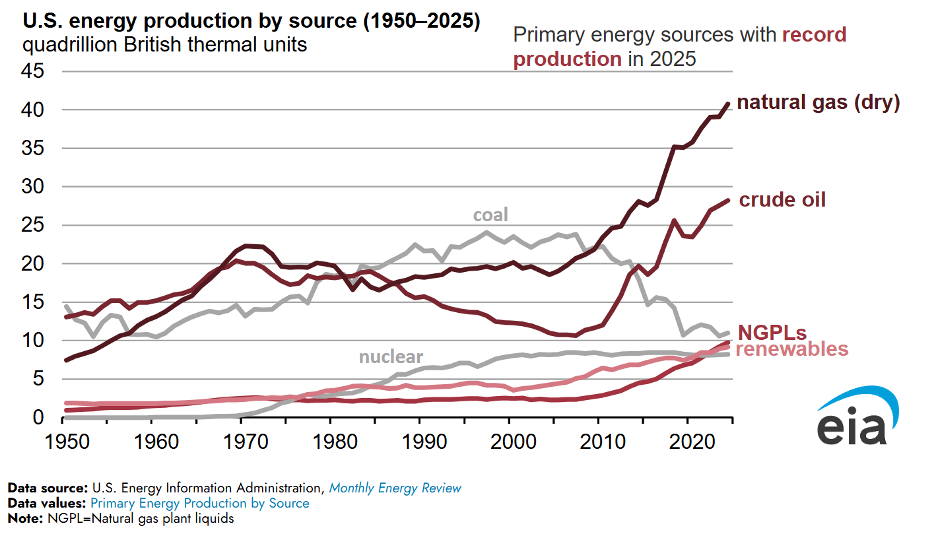
Source: EIA
The United States must modernize and expand its grid infrastructure and software capabilities to meet rising electricity demand and support national decarbonization targets, including a carbon-pollution-free power sector by 2035 and a fully carbon-free economy by 2050. The existing grid has exceeded its intended lifespan; while still operational, it is not equipped to meet the needs of a rapidly evolving energy landscape that requires resilience, security, and flexibility.
Significant opportunities exist to deploy proven grid technologies at scale. High-voltage direct current (HVDC) transmission and grid-enhancing technologies (GETs), both widely implemented across Europe, offer clear pathways to increase transmission capacity and operational efficiency in the United States. The U.S. Department of Energy (DOE) also identified upgrading the existing U.S. grid infrastructure through reconductoring, particularly with advanced conductors capable of doubling capacity.
DOE has also identified energy storage systems and microgrids as important solutions.
Energy storage systems enable electricity generated during periods of high production, such as sunny or windy conditions, to be stored and used across varying time horizons, from hours to months. These systems also support essential grid services, including frequency regulation and load balancing.
- Numerous national labs are working on this topic including:
- Argonne’s ACCESS approaches complex energy storage challenges through multidisciplinary research
- Sandia’s vision for advancing electric grid includes various energy storage initiatives, spanning fundamental research and development (R&D) to large-scale demonstration and deployment efforts.
- Idaho National Laboratory is approaching modernization offering real-time simulations and testing of storage and grid stability, microgrid integrations, dynamic resources, nuclear-alternative systems, and distinctive capabilities.
- Pacific Northwest National Laboratory (PNNL) connects cutting-edge scientists with end-use domain experts in order to develop new energy storage technologies.
- Berkeley Lab’s approach is to combine discovery science with applied, systems-level research that covers a broad portfolio of energy storage systems.
- National Laboratory of the Rockies (NLR) is driving R&D, demonstration and deployment of integrated energy storage solutions.
Microgrids integrate local generation, storage, and demand within defined geographic areas, allowing them to operate independently from the broader grid when needed, thereby enhancing resilience.
The following is a list of federal labs with an emphasis on microgrids:
- Sandia National Laboratories (SNL) houses the Distributed Energy Technologies Laboratory which evaluates distributed energy resources connected to the utility grid.
- Idaho National Laboratory through the Distributed Energy and Grid Systems Integration research program focuses on modeling and simulation, microgrid testing and demonstration, electric vehicles, and industrial scale solutions.
- The National Renewable Energy Laboratory (NREL) focuses on renewable energy and energy efficiency technologies. Through its’ Office of Electricity it provides the Community Microgrid Assistance Partnership (C-MAP). Applications will be open until July 10, 2026 for Microgrid Support Services.
Market Research by Jennifer Ostromecki
Updated June 29, 2026
Key Challenges
The U.S. power grid is producing record levels of energy, but transmission networks are experiencing unprecedented strain. Current challenges include an aging infrastructure, rising usage demands, and growing cyber risks. In response to Executive Order 14262 issued in April 2025, the Department of Energy released its Report on Evaluating U.S. Grid Reliability and Security on July 7, 2025. The key finding was that the current approach to grid planning is no longer sustainable and changes are needed to meet the projected demand growth.
Administration Priorities
The graphic below outlines the Executive Orders and the Office of Electricity’s priorities to meet those demands.
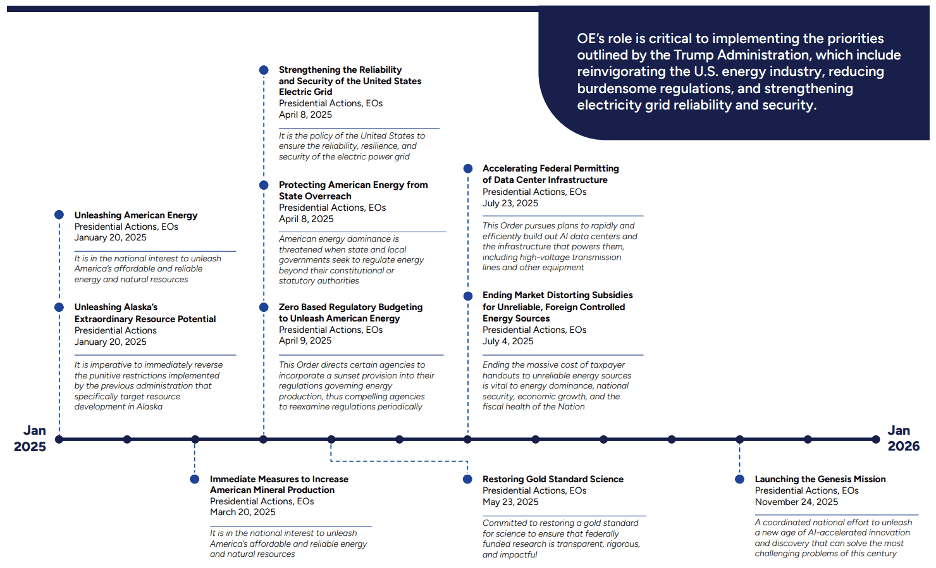
Source: DOE, 2026
Power Capacity Retirements
Electricity demand is growing quickly from data centers, AI, manufacturing, electrification, and population shifts, and that growth is outpacing the grid’s ability to add new capacity and interconnection. There are a series of scheduled retirements, which would equate to 104 GW of firm capacity are set for retirement by 2030. Unfortunately, DOE’s model showed this capacity is not being replaced on a one-to-one basis. Losing this generation could lead to potential significant outages in the future. While the 104 GW of retirements are predicted to be replaced by 2030 with 209 GW of new generation, only 22 GW would come from firm baseload generation sources. Even assuming no retirements, the model found increased risk of outages in 2030 by a factor of 34.
Several coal-fired plant retirements that were scheduled for 2025 were postponed to 2026. Meanwhile, approximately 1% of the operating natural gas fleet is scheduled for retirement in 2026. The combination of these retirements equates to almost 11 gigawatts (GW) of utility-scale electric generating capacity.
Planned U.S. Utility-scale Electric Capacity Retirements, 2026a
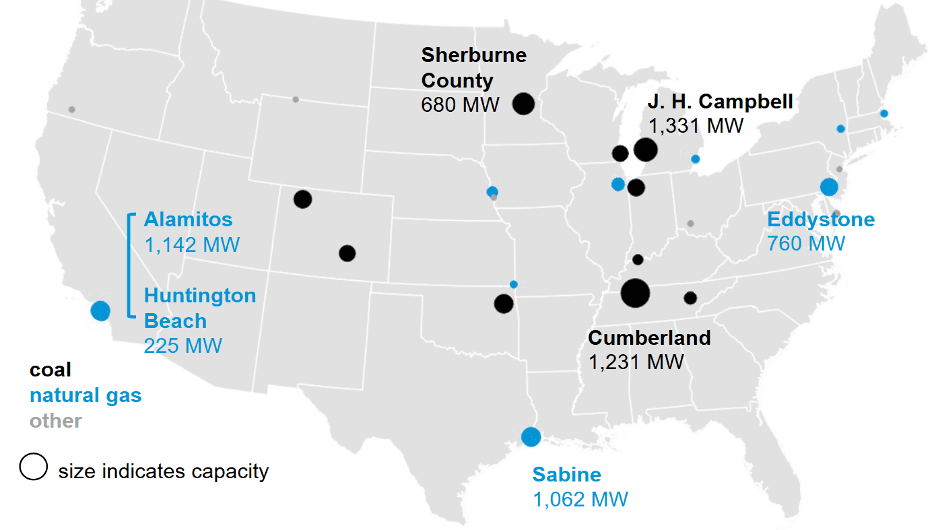
Source: EIA
Aging Infrastructure
Much of the core U.S. electric infrastructure was built 50 to 75 years ago and is now under strain from modern energy demand, severe weather, and the shift to renewable power. The grid was not designed and built to handle the current loads required. If not addressed, an aging infrastructure contributes to frequent power outages, higher costs, inefficiency and energy loss, and cybersecurity risks.
Cybersecurity
As the electric grid evolves and becomes dependent on information networks for operational reliability, it becomes a target for cyberattacks. Risks include disrupting operations, damaging specialized equipment, and endangering human health and safety. Approximately 90% of the grid is owned and operated by private industry. However, the federal government plays a major role in tackling cybersecurity risks facing the electricity grid. In 2025, Executive Order 14262 identified grid cybersecurity as a national security issue and outlined priorities to strengthen its reliability and security. Then, in March 2026, DOE’s Office of Cybersecurity, Energy Security, and Emergency Response (CESER) issued a five-year Strategic Plan intended to bolster the U.S. energy sector against a complex threat landscape. CESER’s three strategic goals are:
- Develop World-Class Security Technologies — CESER will partner with utilities to develop practical, scalable technologies.
- Harden U.S. Energy Infrastructure — CESER will establish cybersecurity measures to protect against energy disruptions and failures.
- Respond and Recover from Incidents — CESER will be the lead U.S. government coordinating agency for the energy sector during emergencies.
Grid and AI Growth
There is a significant demand for electricity. Data center deployment, partially driven by the need to power new AI applications, is one of those driving factors. The current grid is unable to match the speed and projected load needed for AI growth requirements while maintaining a reliable and affordable power grid for U.S. citizens.
Examples of Tools to Address Growing Electricity Demand from Data Centers
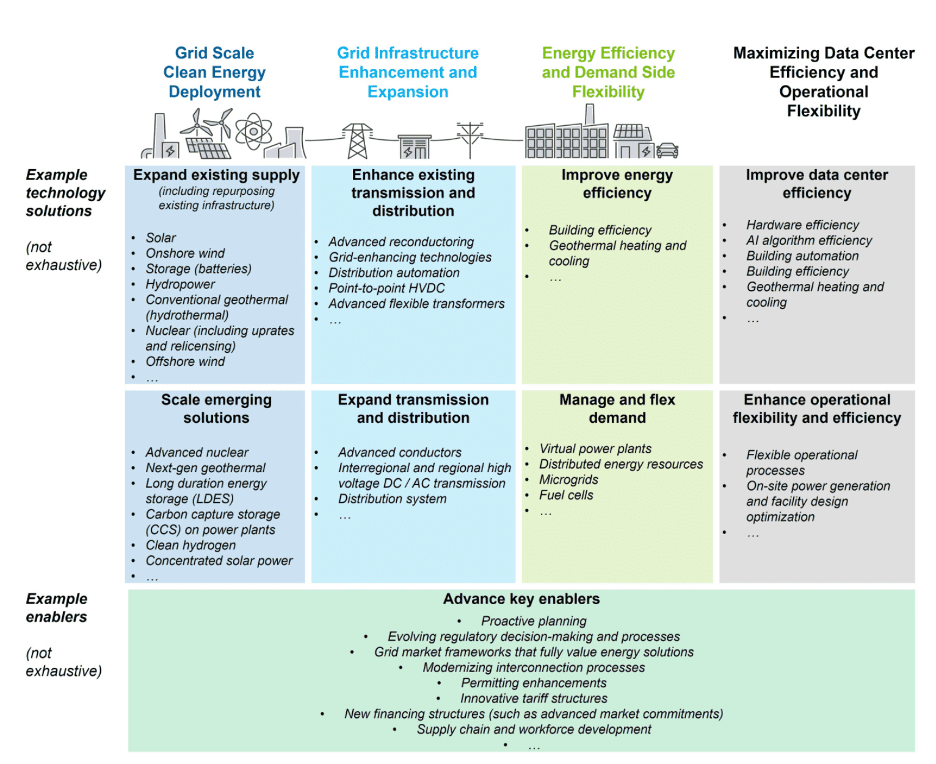
Source: DOE
Market Research by Jennifer Ostromecki
Updated June 30, 2026
Knowledge Hub
This page provides links to recent industry roadmaps and publications related to nuclear energy technologies.
Office of Electricity Strategic Plan (2026):
This plan identifies five critical grid challenges (scaling for new load, delivering affordability, modernizing for reliability, achieving security and resilience, and advancing supply chain security) and the necessary actions for grid improvements.
This federally mandated, model-based report from the U.S. Energy Information Administration (EIA) presents a range of possible U.S. energy futures under current laws and assumptions.
FY 2026 Congressional Justification:
The DOE’s FY 2026 Congressional Justification for the Office of Electricity outlines proposed funding, priorities, and program changes for grid reliability, resilience, cyber-secure utility communications, and related energy-delivery research.
Evaluating the Reliability and Security of the United States Electric Grid (2025):
This DOE report evaluates the reliability and security of the U.S. electric grid, and discusses risks that may emerge as demand grows and generation capacity declines as retirements of current generation sources proceed.
This 156-page document from the Energy Transitions Commission includes a global overview of how to improve grids worldwide.
VPP Cybersecurity: Stakeholder Roles and Responsibilities (2025):
This PowerPoint presentation from the Aggregation and Grid Security Workshop held at NRL focused on addressing cybersecurity challenges and enhancing grid resilience for VPPs and DERs.
Reliability of the Current Power Grid (2024):
The fact sheet covers the reliability trends of the U.S. power grid, 2013-2021.
Conferences
AEE World Energy Conference & Expo
September 16-18, 2026, Orlando, Florida
This event brings together over 2,000 leaders from industry, government, utilities, and organizations to share insights, discuss real-world case studies, and explore emerging energy technologies.
September 29-30, 2026, Salt Lake City, Utah
GridFWD 2026 brings together diverse grid stakeholders to examine rising electricity costs and explore the technologies, policies, and strategies needed to keep power affordable for all. The event includes a Grid Innovation Pitch Competition.
October 20-23, 2026, Orlando, Florida
GridSecCon is North America’s largest grid security conference, co-hosted by NERC, bringing together industry experts and government leaders for training, collaboration, and networking focused on protecting the electricity sector.
December 1-3, 2026, Austin, Texas
This event brings together utility leaders, technology providers, and project developers to share insights, network, and shape the future of the U.S. power market and its evolving value chain.
December 8–9, 2026, Houston, Texas
This event has over 1,500 attendees comprised of project owners, financiers, grid operators, EPCs, policymakers, and technology innovators focused on the whole energy value chain.
April 19-22, 2027, Salt Lake City, Utah
Join this specialized event where utilities, customers, and distributed energy resources intersect. This event draws leaders who are redefining how energy is delivered, managed, and scaled.
Explore Other Energy Sources
Stay in the Know with Dawnbreaker®
Receive valuable industry insights such as our Market Snapshots, SBIR/STTR & TABA updates, & webinar announcements.