Clean Coal
Priorities: Unleash American coal production
- Overview
- Key Challenges
- Knowledge Hub
- Conferences
Clean Coal Overview
Clean coal or advanced coal technologies can encompass more efficient and lower-emissions uses of coal as fuel, as well as conversion of coal and coal waste into high-value products. While the American coal industry has been in decline for decades, the advancement of coal technology is receiving renewed attention under the current administration.
Overall global coal consumption has plateaued and is expected to decrease by 2030 to 2023 levels. As the Congressional Research Service explains, U.S. coal production peaked in 2008, and coal consumption peaked in 2007. Then, between 2007 and 2024, consumption decreased 64%, largely due to retirements in the aging coal-fired power plant fleet. In 2024, while the electric power sector accounted for 87.6% (373.3 million short tons) of coal consumed in the U.S., coal constituted just 8% of primary energy consumption. The U.S. Energy Information Administration (EIA) projects that the share of coal used in the U.S. for electricity generation will continue to decrease through 2050 in all projected policy scenarios. At the same time, the U.S. has the largest coal reserves and resources in the world, with about 11.2 billion short tons of recoverable domestic coal reserves at working mines as of 2023.
There are a variety of responses to the gap between slowing demand for coal and the U.S.’s extensive supply. Under the Trump administration, DOE’s Hydrocarbons and Geothermal Energy Office (HGEO), which houses the Office of Coal, is promoting modernization of existing coal mines and coal-based power plants and expansion of U.S. coal export capacity. Other priorities include carbon capture for coal technologies and converting coal, coal byproducts, and coal waste into high-value carbon-based materials (building materials, battery materials, carbon fiber, synthetic graphite, other fuels, etc.). Extraction of critical minerals from coal, coal byproducts, and coal waste comes under the purview of DOE’s Office of Critical Minerals and Energy Innovation. DOE’s National Energy Technology Laboratory (NETL) Coal Center of Excellence (Morgantown, WV) is a major hub for coal RD&D efforts.
U.S. Coal Production
In the U.S., coal is mainly found in three regions, as identified by the U.S. Energy Information Administration (EIA). In 2024, the most recent year for which EIA data is available, U.S. coal production came from:
- Appalachian coal region (AL, eastern KY, MD, OH, PA, TN, VA, WV): 31%
- Interior coal region (AR, IL, IN, KS, LA, MS, MO, OK, TX, western KY): 16%
- Western coal region (AK, AZ, CO, MN, NM, ND, UT, WA, WY): 53%
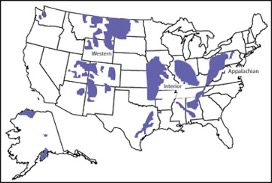
Source: U.S. EIA, 2025
According to EIA’s most recent Annual Coal Report, released in November 2025 with data for 2024, total U.S. coal production in 2024 stood at 512.5 million short tons, up 11% from 2023. Wyoming is by far the top coal-producing state, responsible for 37%, or 190.7 million short tons, of U.S. production. In fact, Wyoming has been the top coal-producing state since 1986. In 2024, the top 5 states which made up 73% of U.S. coal production were:
- Wyoming (37%)
- West Virginia (16%)
- Pennsylvania (8%)
- Illinois (7%)
- Montana (5%)
The largest coal field in the country is in the Powder River Basin in Montana and Wyoming. Of the top 5 coal-producing mines in 2024, four are in Wyoming, and one is in Montana. The most productive mine, Peabody Energy Corp.’s North Antelope Rochelle Mine, produced 59.8 million short tons alone in 2024 – about 11% of all coal produced in the U.S. that year. Significant coal production occurs on federal lands, particularly in the West. In 2023, for instance, all coal produced in Wyoming and over 1/3 of coal produced in Montana came from federal lands. Top coal-producing companies in the U.S., per EIA’s 2024 data, include Peabody Energy Corp., Core Natural Resources Inc., Navajo Transitional Energy Co., and Alliance Resource Partners LP.
Coal Byproducts and Waste
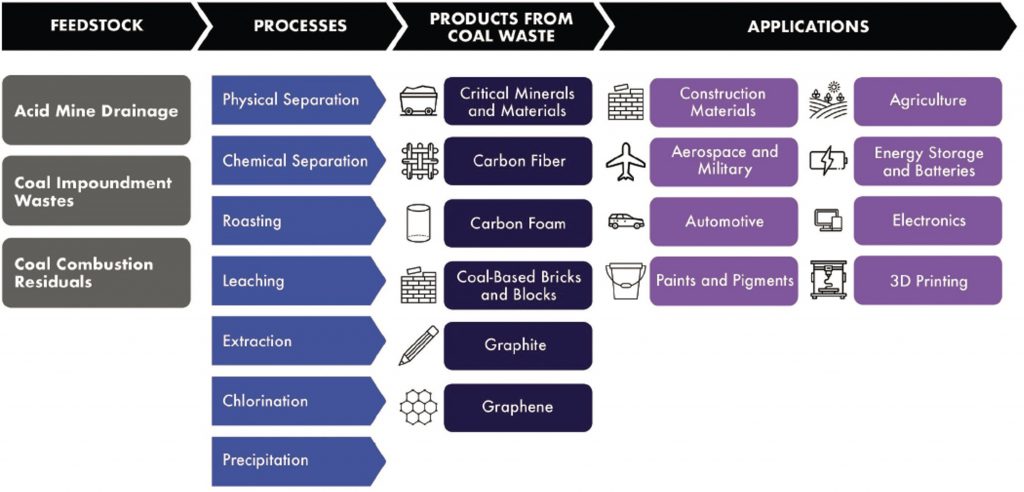
Waste is created throughout the coal supply chain. Some coal waste streams, including acid mine drainage, coal impoundment wastes, and coal combustion residuals (CCRs), are potential feedstocks for carbon-based products and sources of critical minerals and materials.
Coal Supply Chain: Waste Streams & Potential Products
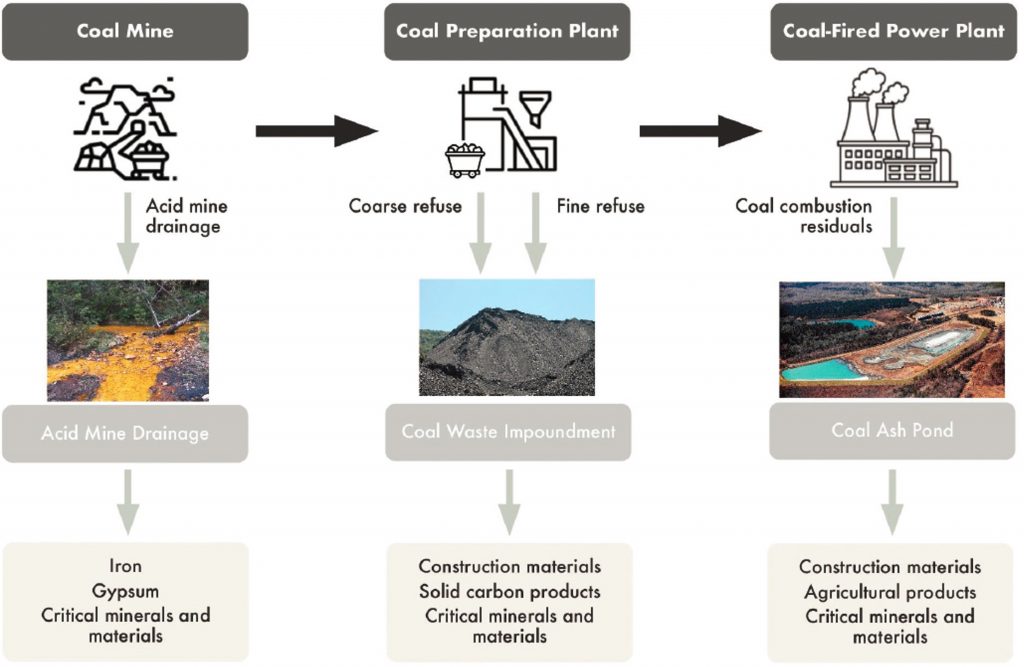
Source: NASEM, 2024
As described in chapter 9 of the National Academies’ 2024 report on carbon utilization, coal impoundment waste, also called coal slurry, coal refuse, or coal sludge, is a byproduct of coal processing and cleaning. Impoundment waste, typically stored in large containment structures (impoundments), is a mixture of water, small particles of coal, and other substances resulting from coal mining and processing. About 30% of mined coal is rejected as waste at the preparation plant, and about 70-90 million tons of impoundment waste are generated in the U.S. each year.
Coal combustion residuals (CCRs) or coal combustion products (CCPs) include fly ash, bottom ash, boiler slag, and flue gas desulfurization material, among others. Coal ash is another catchall term used. According to the American Coal Ash Association (ACAA), 63.6 million short tons of coal ash were produced in the U.S. in 2024. About 72% is reused in some way—in the concrete and cement industry, in gypsum panels, or in other applications. Fly ash and bottom ash are typically stored in impoundments near the power plants that generate them.
There are about 2 billion tons of coal ash stored in more than 1,000 impoundments and over 1,000 impoundments containing waste coal across the U.S., according to DOE. The National Academies report that the country’s coal waste is largely concentrated in Appalachia and the Intermountain West.
The Federal Labs will work closely with private industry
In an announcement released by the Office of Technology Commercialization (OTC) it stated that OTC is looking to move technology developed in the Department of Energy Labs into the private sector. The DOE labs have “developed methods to recover critical minerals from coal byproducts like ash and slag. These materials are often considered waste, but they hold high-value elements that are needed in defense systems, electric machinery, and computing. Instead of discarding them, we now have a way to put these resources to use. Section 11 of the Executive Order calls on DOE to accelerate this work. It directs the department to support technologies that extract materials from coal for steelmaking, battery development, and other industrial uses. Much of this foundational research was supported by DOE’s Office of Fossil Energy and Carbon Management (FECM), which has invested in the development of coal-based recovery technologies. OTC is working alongside FECM to help move these technologies forward through partnerships and commercialization support.” Companies interested in these technologies can find out more in this article and contact the Lab Partnering Service for more details. DOE is also making funding mechanisms available to the labs and industry to commercialize these technologies. Companies interested in funding opportunities from the Office of Critical Minerals and Energy Innovation (CMEI) can sign up to receive notices from their Listserv. Those interested in learning more about the DOE Funding Opportunity Exchange can reach out here.
Market Research by Desiree Zingarelli-Sweet
Updated June 10, 2026
Key Challenges
Current federal coal technology R&D priorities are reflected in the orientations of the DOE Hydrocarbons and Geothermal Energy Office (HGEO)’s Office of Coal and the National Energy Technology Laboratory (NETL)’s Coal Center of Excellence, as well as HGEO’s FY 2027 budget request. The HGEO Office of Coal supports research, development, and demonstration (RD&D) “to stabilize, optimize, and grow the entire coal industry value chain and restore coal as a cornerstone of the U.S. energy mix.” It has 3 major divisions – Mining & Processing, Conversion & Products, and Power & Capture – through which some of the key challenges may be introduced.
Mining & Processing
The HGEO Office of Coal’s Mining & Processing division focuses on “moderniz[ing] coal mining and processing, extend[ing] the life of existing mines, and grow[ing] the industry by enabling recovery of coal from seams previously considered unmineable” and of coal and coal-based products from existing and prior mining processing streams. Proposed FY 2027 priority R&D areas include:
Mining & Processing Innovation:
- Efficiency & safety improvement through use of AI tools, robotics and automation, digital twins, etc.
- Plasma-assisted advanced processing
- Enhanced coalbed methane recovery and underground gasification.
Exports, Logistics & Markets:
- Novel beneficiation technologies & separation techniques to enhance monetization & efficiency during coal preparation & transport processes to optimize export logistics.
Conversion & Products
The HGEO Office of Coal’s Conversion & Products division focuses on “bolster[ing] domestic energy security, resilience, and production via coal-derived fuels and chemicals, while also generating opportunities for new export markets for coal-derived products.” These include:
- High-value carbon-based materials from coal & conversion of waste to products (graphite, carbon fibers, pitch, carbon nanomaterials, battery anodes, supercapacitor materials, conductive inks. composite additives, building material, etc.)
- Cost-effective & selective upgrading of coal by-products to fuels & chemicals
- Gasification (creating syngas and other products).
Coal Waste Utilization to Produce Solid Carbon Products & Extract Critical Minerals
Source: NASEM, 2024
For more on coal waste utilization technology, see NASEM’s 2024 report.
Two significant challenges in the coal-to-products pipeline are:
- Coal’s inherent heterogeneity (see e.g., USGS COALQUAL database) – how to take advantage of variations in domestic coals while minimizing impact of impurities
- End-product performance – controlling, optimizing, and tailoring to specific applications.
Power & Capture
Electricity Cost & Plant Efficiency
Power from a new coal plant costs as estimated $122 per megawatt hour (MWh), Lazard data for 2025 shows, compared with $78/MWh for a comparable natural gas facility (combined cycle). (Combined cycle gas turbines account for most of the natural gas-fired generating capacity in the U.S.) Onshore wind-generated and utility-scale solar-generated electricity came in at $61/MWh and $58/MWh, respectively.
The average U.S. coal-fired power plant operates at about 33% efficiency (Higher Heating Value or HHV). DOE envisions a future coal fleet whose units are based on high efficiency designs, oxy-combustion, chemical looping, and flexible operation and that operate at 40%+ efficiency or higher. DOE also envisions:
- Modular (unit sizes of about 50–350 MW), to minimize field construction costs and project cycle time
- Capable of high ramp rates (>4%/min) and low load (<20%)
- Minimized water consumption
- Reduced design, construction, and commissioning schedules by leveraging advanced process engineering, parametric design methods, and other techniques
- Improved maintenance features, including advances in monitoring and diagnostics to reduce maintenance and minimize outages
- Integration with coal upgrading or other plant value streams (e.g., co-production).
Carbon Capture and Utilization
Supporting further development of technologies for the capture and conversion of coal plant waste streams—including CO2, SO2, wastewater, and coal combustion residuals (CCRs)—into co-products (e.g., gypsum, hydrocarbon recovery through CO2-enhanced oil and gas recovery) is aimed at improving the economic competitiveness of coal power plants. DOE envisions a future coal power fleet wherein all plants are equipped for carbon capture.
Market Research by Desiree Zingarelli-Sweet
Updated June 11, 2026
Knowledge Hub
Fact Sheets
Issued by DOE’s former Office of Fossil Energy and Carbon Management, the document briefly explains types of coal, coal-fired power plants and their emissions, how coal is mined, and the recovery of critical minerals and other materials from coal, coal by-products, and coal waste.
The Department of Energy Is Ending the War on Beautiful, Clean Coal: Fact Sheet (2026)
Released by DOE in January 2026, this fact sheet summarizes measures taken in 2025 by the Trump Administration to re-establish coal as central to the country’s energy economy.
The Energy Department Is Unleashing Beautiful, Clean Coal: Fact Sheet (2026)
DOE released this fact sheet in June 2026, summarizing measures taken in the 1st half of 2026 by the Trump Administration to re-establish coal as central to the country’s energy economy.
Roadmaps
Roadmap for a Sustainable Coal Value Chain (2024)
Published by the industry group Future Coal in December 2024, this roadmap outlines how coal can play a key role in helping achieve net zero by 2050 and assesses the potential of various advanced coal technologies applied pre-combustion, during combustion, after combustion, or without combustion (e.g., using coal to create other products).
DOE Fossil Energy Roadmap (2020)
Issued under the first Trump Administration, this roadmap sets out R&D priorities for the former DOE Office of Fossil Energy and Carbon Management that include modernizing the existing coal-fired power plant fleet, developing High-Efficiency, Low-Emissions (HELE) power generation power systems that utilize coal, and developing high-value carbon products made from domestic coal, among others.
Other Documents
DOE Hydrocarbons and Geothermal Energy Office Strategic Plan, 2026-2036 (2026)
Issued in May 2026, the HGEO Office’s strategic plan gives “Stabilize, Optimize, and Grow the American Coal Industry” as the first of its 7 strategic goals.
U.S. Coal Industry Trends (2025)
The Congressional Research Service issued this 18-page report in November 2025.
Market Research by Desirae Zingarelli-Sweet
Updated June 11, 2026
Conferences and upcoming major events
Carbon 2026: World Conference on Carbon
July 12-17, 2026 | Charleston, SC
Abstracts due December 19th, 2025
Held in the U.S. every 3 years, this carbon materials conference brings together members of the American Carbon Society, European Carbon Association, Carbon Society of Japan, and others from academia and industry.[1]
International Conference on Carbon Dioxide Utilization (ICCDU)
June 21-26, 2026 | Boulder, Colorado
Abstracts due February 2, 2026
2026 marks the 23rd ICCDU, organized by the National Renewable Energy Laboratory (NREL), University of Colorado Boulder (CU Boulder) and the Renewable and Sustainable Energy Institute (RASEI). The 2024 conference attracted more than 500 attendees.[4]
World of Coal Ash (WOCA) Conference
May 4-7, 2026 | Lexington, KY
Abstracts due December 15, 2025
2026 is the 11th joint biennial World of Coal Ash (WOCA) is a biennial conference, organized by the American Coal Ash Association (ACAA) and the University of Kentucky Center for Applied Energy Research (CAER). The last event in 2024 had about 1,200 attendees.
FECM / NETL Carbon Management Research Project Review Meeting
June 22-26, 2026 | Pittsburgh, PA
Attendees at this open-to-the-public meeting have a chance to share in the insights gained through more than 300 projects sponsored by the DOE Office of Fossil Energy & Carbon Management R&D programs in carbon conversion, point source carbon capture, carbon dioxide removal, carbon transport and storage, and hydrogen with carbon management.
Market Research by Desirae Zingarelli-Sweet
Updated June 11, 2026
Explore Other Energy Sources
Stay in the Know with Dawnbreaker®
Receive valuable industry insights such as our Market Snapshots, SBIR/STTR & TABA updates, & webinar announcements.