Fusion Energy
Priorities: Commercialize nuclear fusion power rapidly and responsibly
- Overview
- Key Challenges
- Knowledge Hub
- Conferences
Fusion Energy
For almost a century, scientists around the globe have been looking to recreate and harness the power of fusion energy. Federal interest in fusion has grown and there is now a growing commercial fusion industry. Numerous potential fusion concepts are under investigation including magnetic confinement, inertial confinement, and others. Magnetic confinement devices use magnets to confine plasmas. The most common fusion reactors of this kind are tokamak and stellarator. A tokamak uses magnets to confine the plasma within a toroidal reaction vessel, with the magnetic fields keeping the plasma away from the walls to prevent damage and unintended cooling of the plasma. About 60 tokamaks and 10 stellarators are currently operating globally.
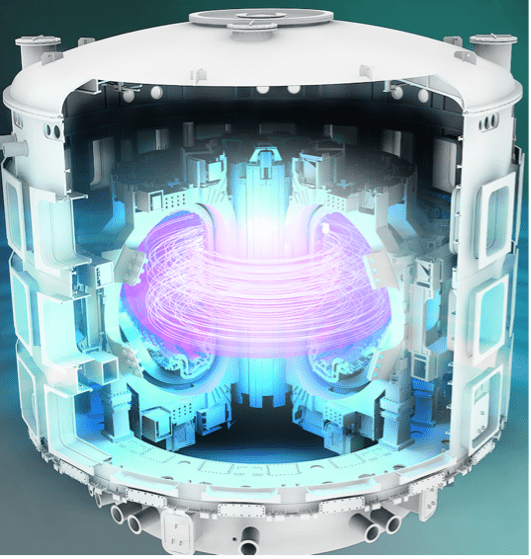
Tokamak
Source: ITER
By contrast, a stellarator uses external magnetic fields to confine plasma in the shape of a donut, called a torus. These magnetic fields allow scientists to control the plasma particles and create the right conditions for fusion. Stellarators use external coils to generate a twisting magnetic field to control the plasma instead of inducing electric currents inside the plasma like a tokamak. There are several stellarators presently in the United States including Auburn University, Hampton University, Columbia University, and Princeton Plasma Physics Laboratory, the University of Illinois, and the University of Wisconsin. Examples of U.S. companies developing magnetic confinement systems are Commonwealth Fusion Systems, TAE Technologies, Tokamak Energy, Helion Energy, and Thea Energy.
In inertial confinement, high power lasers are used to rapidly compress a small capsule of fusion fuel to extreme temperatures and pressures. This approach is used, for example, in the National Ignition Facility at the U.S. Department of Energy (DOE) Lawrence Livermore National Laboratory. Examples of U.S. companies developing inertial confinement systems are Xcimer Energy, Focused Energy, ZAP Energy, and Shine Technologies.
Numerous potential fusion fuels are also being investigated. According to the U.S. Department of Energy, once developed, first-generation fusion plants will likely use a combination of deuterium, lithium and Deuterium-tritium. Lithium is a critical resource for fusion because it is used to breed tritium. The rare lithium-6 form of the metal (Li-6), which makes up of 7.5 per cent of all naturally occurring lithium is the most efficient for sustaining the fusion process. Li-6 is banned in the U.S. because of the mercury waste it generates. So most fusion power concepts rely on “enriched” lithium, where the Li-6 content has been boosted.
Timeline - Fusion Energy on the Grid
Several companies are investing in efforts aimed at commercializing fusion energy. Many of these companies are startups that have raised over $100 million in the past few years. MarketsandMarkets estimates the immediate nuclear fusion market at $18.0 billion in 2026, projecting it to grow to $33.77 billion by 2031 (13.4% CAGR during 2026-2031).
Several companies have announced plans to build grid-scale commercial nuclear fusion power plants, with plans to go online in the early 2030s, according to the “The global fusion industry in 2025.” As of early 2026, fusion reactors remain pre-commercial, with no system yet producing net energy. Fusion energy stakeholders provide varying timelines as to when fusion energy will become technically feasible and commercially viable. Projections range from 10 years to several decades in the future. Other stakeholders and experts believe fusion energy might put electricity on the grid in 10 to 20 years; however, this will require significant resources.
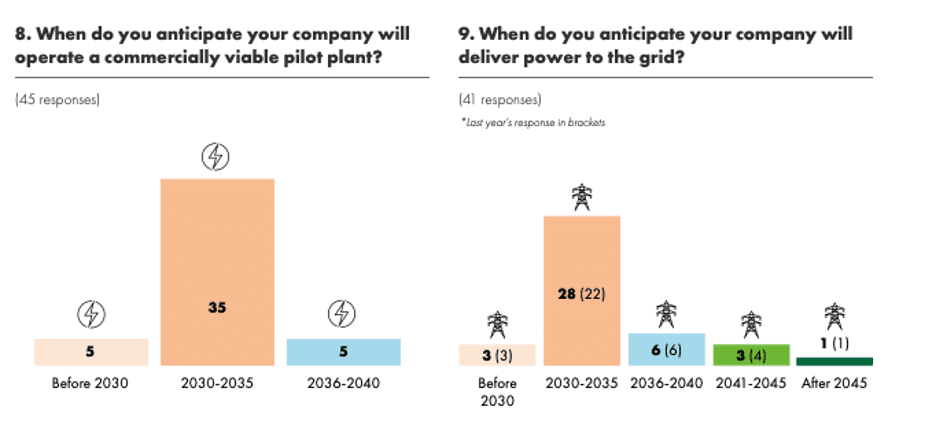
Source: The Global Fusion Industry in 2025—Fusion Industry Association
Some companies claim they will achieve commercial fusion energy in the next few years. However, in general, it is predicted that fusion energy will be commercially viable in the 2030’s time frame. The Figure below illustrates commercialization risks that will need to be overcome. The timeline as shown is very dependent on both public and private investments.
Commercialization risks for fusion

Source. U.S. Department of Energy, Fusion Energy Strategy 2024
Advantages
As a source of power, fusion energy has several potential advantages. Fusion has the potential to be a critical low-carbon energy source. Fusion power promises to provide more energy for a given weight of fuel than any fuel-consuming energy source currently in use. Fusion energy could produce electric power without carbon emissions, long-lived nuclear waste, or risk of meltdowns.
Fusion energy is suitable for rapid, large-scale deployment facilitated by mass manufacturing for the following reasons:
- Fusion is among the most environmentally friendly sources of energy. There are no greenhouse gasses or other harmful atmospheric emissions from the fusion process, which means that fusion does not contribute to global warming.
- Fusion generators consist of assemblies of components built in factories—from capacitors and power switches to cables and magnet. In addition, the shielding blocks and wall tiles for the fusion generators are modular, measuring just a few feet per component in some designs.
- Unlike many traditional energy technologies that require extensive site-specific construction and infrastructure, fusion generators can be standardized, fabricated in controlled environments, and then easily transported to a site for rapid installation.
- Fusion energy is expected to be a compact form of power generation. Fusion generators are anticipated to be sited within a building that is much smaller than nearly any other large power plant.
- Fusion generators require small amounts of deuterium, and lithium as fuel. Deuterium, a common isotope of hydrogen, is found in seawater and is abundant. Li-6 is a source of tritium for nuclear fusion, through low-energy nuclear fission. Both isotopes are also non-radioactive and can be shipped commercially.
Disadvantages
Potential risks that need to be managed include generation of activated waste and managing resulting neutron radiation, which over time degrades the reaction chamber. Because 80 percent of the energy reactors fueled by deuterium and tritium appears in the form of neutron streams, such reactors have several drawbacks including the production of large quantities of radioactive waste and serious radiation damage to reactor components.
Although fusion can generate large amounts of energy from a small fuel supply, it takes significant energy to create a plasma that can sustain fusion. The difficulty has been to develop a device that can heat the D-T fuel to a high enough temperature and confine it long enough so that more energy is released through fusion reactions than is used to get the reaction going.
Additionally, fusion generates energy by fusing light atomic nuclei, typically isotopes of hydrogen, namely deuterium and tritium. Current commercial tritium supplies are limited, largely sourced from heavy-water fission reactors in Canada. The most promising, solution for private companies to access tritium is a tritium breeding within fusion reactors themselves.
Market Research by Kevine Lidoro
Updated July 1, 2026
Key Challenges
Several challenges must be overcome to achieve commercial fusion energy.
Technical Challenges
Several scientific and engineering challenges are identified in a 2023 technology assessment by the United States Government Accountability Office. A key scientific challenge is in the physics of plasmas. Researchers do not fully understand the behavior of burning plasmas, those whose main source of heat is from the fusion reaction itself rather than an external source. A key engineering challenge is the development of materials that can withstand extreme heat and neutron damage for decades, and no facility exists where materials can be fully tested. Another general challenge is the task of extracting energy from fusion to provide an economical source of electric power presents several complex systems engineering problems that have yet to be solved.
Harnessing fusion energy still faces challenges such as physics of a plasma in combustion, heat extraction, manufacturing of components such as the blanket, and plasma facing materials. Below are some of the challenges facing commercialization of fusion energy technology up to 2030 identified in Fusion Industry Association’s The Global Fusion Industry in 2024 report.
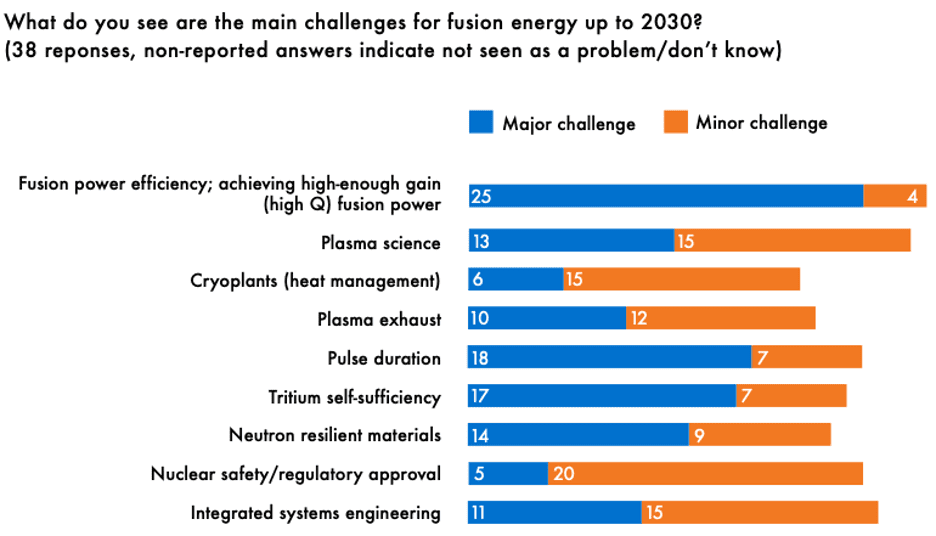
Source. The Global Fusion Industry in 2024—Fusion Industry Association
A long-recognized drawback of fusion energy is neutron radiation damage to exposed materials, causing swelling, embrittlement and fatigue. Plasma-facing components are materials and structures located at the inner walls of a fusion reactor, directly exposed to a large amount of heat energy transferred to a surface in a short period of time (high heat flux), energetic plasma and intense neutron irradiation. The commercial viability of fusion energy depends on developing plasma-facing components capable of the harsh environment.
Supply Chain Challenges
Generally, the biggest supply chain challenge is the ”chicken or egg” problem, whereby suppliers need to know that there will be a market, but it is difficult for fusion companies to commit long-term in advance of hitting timeline milestones. Timelines for a supply chain company to produce a new product at scale can be a matter of years, but most will only start on that journey with firm commitments or investments.
Market Research by Kevine Lidoro
Updated July 1, 2026
Knowledge Hub
Federal Framework
The White House supports the rapid commercialization of nuclear fusion to achieve energy dominance. Key federal actions include releasing the Fusion Science and Technology Roadmap, establishing a standalone Office of Fusion within the Department of Energy (DOE) reporting to the Under Secretary of Science, with the primary responsibility for coordinating all fusion-related activities across DOE and with partners, and streamlining regulations to construct commercial fusion plants.
For more details on the federal framework, you can review the official Department of Energy Fusion Energy resources. You can also read the administration’s policy vision directly in the President Trump Signs Executive Orders.
U.S. Department of Energy Roadmaps
Fusion Science and Technology Roadmap, June, 2026
This newly released document targets actions and milestones out to the mid-2030s, providing the scientific and technological foundation to support a competitive U.S. fusion energy industry. The Roadmap is a national strategy that aims to accelerate the development and commercialization of fusion energy by the mid-2030s.
Unleashing American Energy, January, 2025
This Roadmap advances President Trump’s Executive Order, reinforcing the Administration’s commitment to expand domestic energy production and restore U.S. energy dominance.
Strategy and Assessment Documents
“Building Bridges: A Vision For The Office of Fusion Energy Sciences,” 2024
Released in 2024, this document identifies three strategic actions to help bridge the interests of the private fusion energy sector and the public programs supported by the Office of Science: creating (1) a U.S. Fusion Science & Technology Roadmap; (2) establishing Fusion Innovation Research Engine Ecosystems; and (3) developing a public-private consortium framework supporting fusion energy development.
“Fusion Energy Strategy 2024,”
This document provides and outline of DOE’s vision for the future of the Fusion Energy Sciences program. Three high-level objectives include (1) closing science and technology gaps to a commercially relevant fusion pilot plant; (2) preparing the path to sustainable, equitable commercial fusion energy deployment; and (3) building and leveraging external partnerships.
“Powering the Future: Fusion and Plasmas” December 2020
A Report of the FESAC Long Range Planning Subcommittee, presented as a PPT.
“Bringing Fusion to the U.S. Grid”, 2021
A report prepared by the National Academies of Science
“Fusion Energy: Potentially Transformative Technology Still Faces Fundamental Challenges” 2023
A technology assessment by the Government Accountability Office (GAO)
Market Research by Kevine Lidoro
Updated July 1, 2026
Conferences
Check out this domestic fusion energy conferences taking place in 2026.
August 1, 2026
Registration deadline: October 14, 2025
DIII-D National Fusion Facility, San Diego, California
Registration: 2026 Registration Form
Hosted by the DIII-D National Fusion Facility, the goal of the meeting is to create opportunities for fusion industry suppliers and innovators to identify new partnerships and customers.
DIII-D Industry Day brings together researchers, private partners, and stakeholders to strengthen the fusion ecosystem and accelerate pathways toward practical fusion energy. The event is designed to connect organizations across fusion, including private industry, supply chain, research organizations, and engine.
Washington State Fusion Week – 2026
Everett, Tukwila, Richland
August 31, 2026 – September 2, 2026
Washington Fusion Week brings together the fusion companies, utilities, investors, researchers, and policy leaders building the next generation of clean energy — at WSU Everett and PNNL Discovery Hall in Richland, with optional tours bookending the week.
2026 conference on Additive Manufacturing and Advanced Materials in Fusion (AM2F)
Location: MIT-PSFC building NW17 Room 218 (175 Albany St, Cambridge MA)
Dates: August 31-Sept 2, 2026
Monday, July 13, 2026: Abstracts due
Monday, Aug 24, 2026: Registration closes
Hosted by the MIT Plasma Science and Fusion Center (MIT-PSFC), AM2F will take place in Cambridge, Massachusetts. AM2F focuses on Additive Manufacturing (AM) and advanced materials in fusion power and associated fields (including high-heat flux, vacuum, and Radio Frequency (RF) components). The conference focuses on the intersect between AM, advanced manufacturing techniques, and associated materials development intersect with the fusion reactor environment.
FusionVision 2026 International Fusion Symposium
MIT Kresge Auditorium,48 Massachusetts Ave, Building w16, Cambridge, Massachusetts
September 22 – 24 2026
Presented by IEEE and MIT’s Plasma Science & Fusion Center, FusionVision 2026 unites global experts in plasma science, nuclear physics, electrical engineering, materials engineering, and nuclear energy systems to accelerate the realization of commercial nuclear fusion. The IEEE 2026 International Fusion Symposium will engage directly with leaders from academia and industry, and revisit the past challenges, achievements, and relentless efforts of people working on nuclear fusion.
The Applied Superconductivity Conference (ASC 2026)
David L. Lawrence Convention Center
September 6 -11, 2026
Pittsburgh, Pennsylvania
The conference will offer a forum for sharing and discussing the latest updates and news in the field of applied superconductivity.
October 6-7, 2026
Boston, MA
Cost: Book by July 10, 2026, $1,199 (Save $500)
After July 10: $1,699
This Reuters event brings together more than 250 leaders from across the global fusion energy ecosystem – from reactor developers, utilities and data centers to investors, supply chain partners, policymakers and future customers – to tackle the defining challenges of commercialization including bankable financing models, scalable reactor technology, supply chain readiness, and the regulatory frameworks that will unlock deployment.
Market Research by Kevine Lidoro
Updated July 1, 2026
Explore Other Energy Sources
Stay in the Know with Dawnbreaker®
Receive valuable industry insights such as our Market Snapshots, SBIR/STTR & TABA updates, & webinar announcements.