Critical Minerals & Materials
Priorities: Extract critical minerals from coal ash
- Overview
- Key Challenges
- Knowledge Hub
- Conferences
Critical Minerals and Materials Overview
The Energy Act of 2020, Section 7002(a) defines a “critical mineral” as non-fuel minerals, elements, substances, or materials that the U.S. Geological Survey (USGS) determines are essential to the economic or national security of the U.S.
There are 60 on the 2025 Critical Minerals List: Aluminum, antimony, arsenic, barite, beryllium, bismuth, boron, cerium, cesium, chromium, cobalt, copper, dysprosium, erbium, europium, fluorspar, gadolinium, gallium, germanium, graphite, hafnium, holmium, indium, iridium, lanthanum, lead, lithium, lutetium, magnesium, manganese, metallurgical coal, neodymium, nickel, niobium, palladium, phosphate, platinum, potash, praseodymium, rhenium, rhodium, rubidium, ruthenium, samarium, scandium, silicon, silver, tantalum, tellurium, terbium, thulium, tin, titanium, tungsten, uranium, vanadium, ytterbium, yttrium, zinc, and zirconium.
A “critical material,” also defined in the Energy Act of 2020 but determined by the Department of Energy, is:
(A) any non-fuel mineral, element, substance, or material that the Secretary of Energy determines—
(i) has a high risk of a supply chain disruption; and
(ii) serves an essential function in 1 or more energy technologies, including technologies that produce, transmit, store, and conserve energy; or
(B) a critical mineral.
Currently, the only critical materials that aren’t USGS-designated critical minerals are electrical steel and silicon carbide. DOE released the following medium-term (2025–2035) criticality matrix as part of its July 2023 Critical Minerals Assessment report.
Mid-Term (2024-2035) Critical Mineral Criticality Matrix
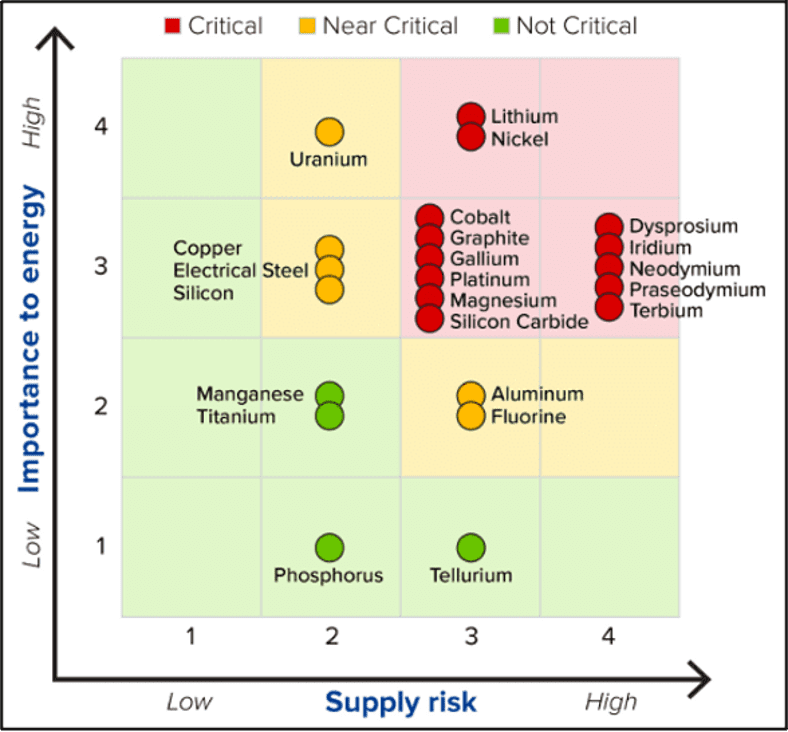
Source: DOE, 2023
Strategy
DOE’s critical minerals and materials strategy has 4 pillars: diversify and expand supply, develop alternatives, improve material and manufacturing efficiency, and reuse and recycle.
DOE Critical Minerals & Materials Strategy
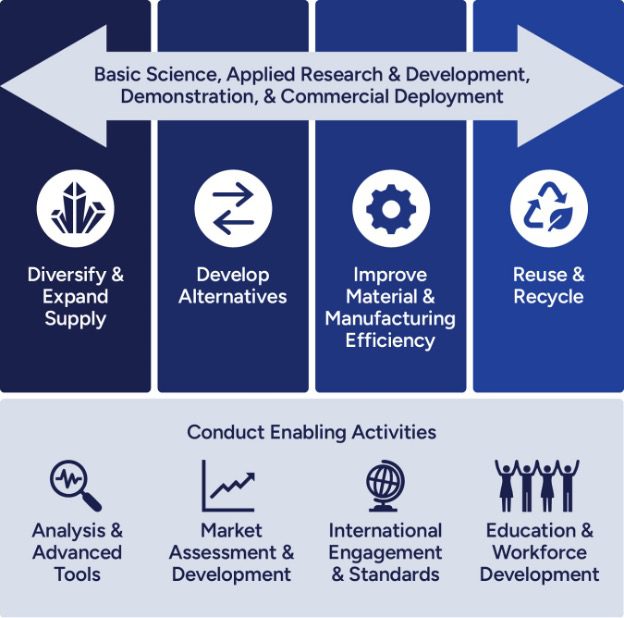
Source: DOE, 2026
Market Research by Desirae Zingarelli-Sweet
Updated June 30, 2026
Key Challenges
Extraction
Diversifying and expanding the critical mineral and material (CMM) supply and developing alternatives are two of the four pillars of DOE’s CMM strategy. Lack of extraction activities in the U.S. makes the domestic supply of CMMs vulnerable to global supply chain disruptions.
Separating rare earth elements (REEs) from one another, for example, is a complex, high-energy and costly process – due to their having such similar chemical properties. Traditional REE processing uses vast amounts of toxic chemicals, and the process often generates radioactive and hazardous waste. Promising new extraction and separation methods exist at laboratory scale and primarily include the use of solvents or supercritical CO2. Bio-based extraction, including biomining with microbes, is also a potential approach under development. While ongoing research utilizing these methods focuses on safer, more sustainable alternatives to traditional processes, the technology for large-scale and cost-effective production is not yet scalable.
Cost-competitive, direct lithium extraction is another research area of interest. This is funded by the Office of Critical Minerals and Energy Innovation (CMEI) Advanced Materials and Manufacturing Technologies Office (AMMTO)’s through its $69 million Critical Minerals and Materials Accelerator program.
CMEI’s Advanced Mining and Mineral Processing Technologies (AMMPT) Office funds advanced R&D for mineral resource characterization, extraction, and extractive metallurgical processing, including the Minerals to Materials Supply Chain Research Facility (METALLIC) program, headed by DOE’s National Energy Technology Laboratory (NETL). This organization’s activities span feedstock beneficiation, extractions and separations, refining, and alloy development, as well as advanced manufacturing.
DOE’s Critical Material Innovation Hub is another program that addresses technical challenges related to CMM extraction, conducting research in 4 main areas: (1) enhancing and diversifying supply; (2) developing substitutes; (3) unlocking secondary sources; and (4) cross-cutting research. Another program is the $134 million Rare Earth Elements Demonstration Facility program. The purpose of this program is to demonstrate the feasibility of a full-scale integrated rare earth element extraction and separation facility and refinery, using feedstock derived from acid mine drainage, mine waste, or other deleterious materials.
Recovery from Coal and Coal-Based Feedstocks
Industrial wastewater, mine tailings, acid mine drainage, coal, coal byproducts, and coal ash are among the non-traditional CMM feedstocks being explored. In November 2025, DOE announced the $275 million Mines & Metals Capacity Expansion – Piloting Byproduct Critical Minerals and Materials Recovery at Domestic Industrial Facilities funding opportunity, aimed at demonstrating the feasibility of producing critical minerals and materials from coal, coal byproducts, and other industrial byproducts (e.g., mining and minerals processing, power generation, oil and gas). DOE awarded $75 million to five such projects in July 2026. While NETL has been investigating the possibility of extracting critical minerals from coal and coal byproducts since at least 2012, these recent developments reflect a greater priority placed on developing these technologies. In 2025, DOE also highlighted some of the coal-based recovery technologies tested by the national labs and which are ready for companies to further develop and commercialize.
Coal ash, generated by coal-fired power plants, is one particularly promising feedstock. Over 1.5 billion tons have been landfilled since 1991. Coal ash contains higher concentrations of rare earth elements than uncombusted coal —— about 400 ppm on average. DOE is actively promoting coal ash conversion research and partnering with the national labs for commercialization in this area as well.
Processing, Manufacturing, & Recycling
The 3rd and 4th pillars of DOE’s CMM strategy are “to improve material and manufacturing efficiency” and “reuse and recycle.” CMEI’s Advanced Materials and Manufacturing Technologies Office (AMMTO) sponsors RD&D for innovative, CMM-focused manufacturing technologies that provide energy solutions, such as energy storage systems and wide bandgap power semiconductors.
According to the International Energy Agency (IEA), by scaling up recycling, the need for newly mined critical minerals could be brought down by between 25% and 40% by 2050. However, many CMM recycling processes are not economically feasible. In fact, recycling REEs and some other CMMs from end-of-life products can actually be more expensive than extraction, due to the low concentrations in most consumer devices. Because REEs are used in such miniscule amounts that are closely integrated into complex electronic and magnet components, extracting them requires manual disassembly, which is highly labor-intensive and time-consuming. Current recycling technologies use high heat and/or harsh chemicals, which are inefficient and can be harmful to the environment. There is a need for more advanced recycling sorting and molecular separation techniques.
Battery Manufacturing & Recycling
In 2025, the DOE Office of Manufacturing and Energy Supply Chains (MESC) announced up to $500 million in funding through the Battery Materials Process and Battery Manufacturing and Recycling program. Increasing recovery of battery critical minerals through the recycling of manufacturing scrap, off-specification, and end-of-life batteries and increasing domestic manufacturing capacity for strategic battery materials, components and technologies are 2 specific priorities.
National Lab Capabilities & Engagement Mechanisms
For more on national laboratory capabilities and engagement mechanisms related to critical minerals and materials, see the September 2025 webinar recording. The webinar was sponsored by DOE and the DOE Critical Materials Collaborative. With the Critical Material Innovation Hub, for instance, a company can collaborate by becoming a team member (research participation and cash or in-kind contribution), sponsored research partner (through a CRADA or SPP, with cash sponsorship of a proprietary project), or affiliate (membership fee).
Market Research by Desirae Zingarelli-Sweet
Updated July 8, 2026
Knowledge Hub
Factsheets & Slide Decks
This 49-page slide deck surveys the rationale behind the creation of the Critical Minerals and Materials (CMM) Program and discusses the program’s principles and DOE’s CMM strategy, with examples.
This factsheet provides a quick overview of the DOE Critical Materials Collaborative (CMC).
Critical Materials Innovation Hub: 10 Years of Innovation, Influence, & Impact (2024)
This factsheet summarizes evaluations of the DOE Critical Materials Institute (CMI)’s activities over the last 10 years—a 40-page technical report, patent analysis, and bibliometric analysis.
Strategy & Assessment Documents
Critical Materials Assessment (2023)
DOE’s most recent critical materials assessment was released in July 2023. The 267-page report is an updated analysis of previous Critical Materials Strategy reports published by the DOE in 2010, 2011, and 2019, based on national and global priorities, technology advancement, and technology adoption trends.
DOE released this 10-year critical minerals and materials strategy document in response to President Trump’s Executive Order 13953, Addressing the Threat to the Domestic Supply Chain from Reliance on Critical Minerals from Foreign Adversaries and Supporting the Domestic Mining and Processing Industries. This 50-page report follows on DOE’s February 2019 critical materials strategy and assessment document.
Other
Critical Mineral Resources: National Policy and Critical Minerals List (2026)
Published in January 2026, this 27-page Congressional Research Service report provides an overview of critical minerals and materials and U.S. policy over the last 10 years.
Market Research by Desirae Zingarelli-Sweet
Updated June 30, 2026
Conferences
Critical Minerals, Battery Recycling, and E-Waste World (CBE) Expo
October 28-29, 2026, Atlanta, GA
This combined expo is a North American B2B conference and trade fair for the critical minerals industry writ large, attracting about 1,500 attendees.
Critical Minerals & Materials Science Summit (CM2S2)
November 3-5, 2026, Richland, WA
This summit is an interdisciplinary conference bringing together leaders from national laboratories government, industry, and academia, hosted by DOE Pacific Northwest National Laboratory (PNNL) and the Pacific Northwest chapter of the American Vacuum Society Science & Technology Society.
Critical Minerals North American Conference & Exhibition
April 19-20, 2027, New York, NY
Run by Spire Events, this 2-day annual conference is “Americas’ longest running international critical minerals, commodities, investment, new energy & technologies show,” bringing together over 300 professionals from the entire mineral resources value chain. (See 2027 speaker list.)
MINEXCHANGE 2027: SME Annual Conference & Expo
February 28, March 3, 2027, Denver, CO
The Society for Mining, Metallurgy & Exploration (SME)’s annual conference, MINEXCHANGE, attracts more than 7,400 attendees, including mining professionals, engineers, and vendors.
Market Research by Desirae Zingarelli-Sweet
Updated June 30, 2026
Explore Other Energy Sources
Stay in the Know with Dawnbreaker®
Receive valuable industry insights such as our Market Snapshots, SBIR/STTR & TABA updates, & webinar announcements.