Fusion Energy
Fusion is a potential energy source and occurs when one or more lighter elements combine to form a heavier element, releasing energy in the process.
- Overview
- Advantages
- Disadvantages
- Technology Gaps
- Roadmaps & Resources
- Funding
- Conferences
Fusion Energy
Fusion is a potential energy source and occurs when one or more lighter elements combine to form a heavier element, releasing energy in the process. [1] Devices designed to harness this energy are known as fusion reactors. [2] A future fusion plant could use the heat produced by the fusion reaction to produce steam to drive turbines or generators that produce electricity. [3] For almost a century, scientists around the globe have been looking to recreate and harness the power of fusion energy. [4]
There are two commonly pursued technologies to create and control plasma. Magnetic confinement uses strong magnets to contain plasma. A widely used configuration known as a tokamak[5] uses powerful magnets to confine the plasma within a toroidal reaction vessel, with the magnetic fields keeping the plasma away from the walls of the vessel to prevent damage and unintended cooling of the plasma.[6]
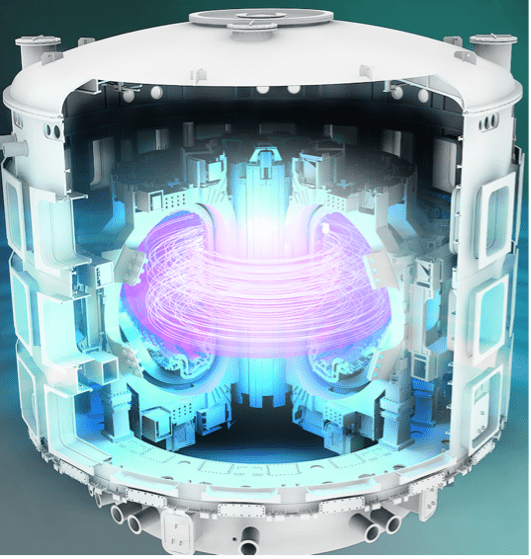
Tokamak
Source: ITER
Examples of U.S. companies developing magnetic confinement systems are Commonwealth Fusion Systems, TAE Technologies, Tokamak Energy, Helion Energy, and Thea Energy. Inertial confinement uses high-power lasers or electrical discharges to compress a small capsule of fusion fuel to extreme temperatures and pressures for a short time. This approach is used, for example, in the National Ignition Facility at the U.S. Department of Energy (DOE) Lawrence Livermore National Laboratory. [7] Examples of U.S. companies developing inertial confinement systems are Xcimer Energy, Focused Energy, ZAP Energy, and Shine Technologies. In addition to these methods, several companies such as General Fusion, are pursuing various other pathways to try to create and control fusion reactions, including a hybrid of both magnetic and inertial confinement approaches. [8]
Various fusion fuels are used to power these pursued pathways. According to the U.S. Department of Energy, once developed, first-generation fusion plants may likely use a combination of abundant deuterium and lithium as fuel. [9] Deuterium, lithium and tritium Deuterium-tritium is a highly studied fusion fuel and a likely basis for the first fusion power plants.[10] Lithium is a critical resource for fusion because of its material properties. Lithium is used to breed tritium, the key fuel for fusion. [11] The rare lithium-6 form of the metal, which makes up only 7.5 per cent of all naturally occurring lithium, is the most efficient for sustaining the fusion process. [12] Li-6 is banned in the U.S. because of the harmful mercury waste it generates. [13] So most fusion power concepts rely on “enriched” lithium, where the Li-6 content has been boosted. [14]
Several companies are investing in efforts aimed at commercializing fusion energy. [15] Many of these companies are startups that have raised over $100 million in the past few years. [16] The global fusion energy market size is projected to reach $611.8 billion by 2034, expanding at a CAGR of 5.56% from 2025 to 2034. [17]
Current State - Projections of the time to putting Fusion Energy on the Grid
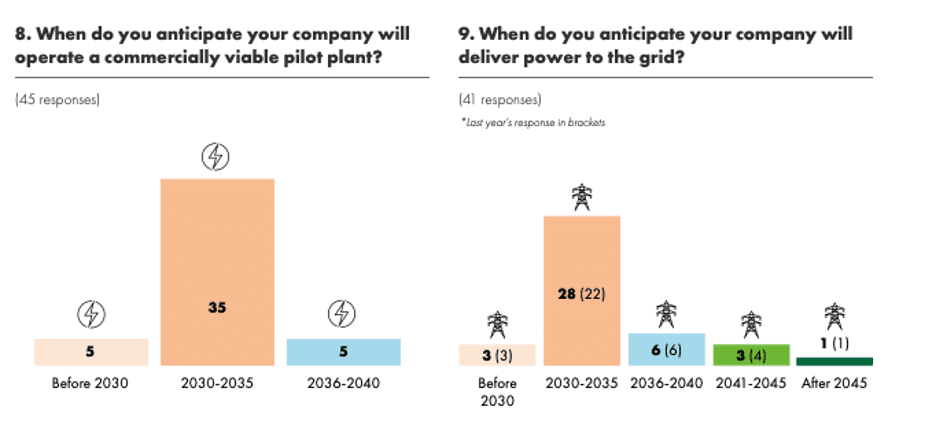
As of October 2025, fusion reactors remain pre-commercial, with no system yet producing net energy. Fusion energy stakeholders provide varying timelines as to when fusion energy will become technically feasible as an energy source for the electrical grid and when it will become commercially viable. Projections range from 10 years to several decades in the future. [18] Some companies are claiming that they will achieve commercial fusion energy in the next few years[19] while other stakeholders and experts said fusion energy will take more than 20 years. The Fusion Industry Association reported that many commercial companies predict fusion industry will be commercially viable in the 2030’s time frame. [19]
Other stakeholders and experts believe fusion energy might put electricity on the grid in 10 to 20 years, however, significant resources are required to do so.[20] The Figure below illustrates commercialization risks that fusion energy will face on the road to commercial deployment. According to the U.S. Department of Energy, the aspirational timeline as shown is strongly dependent on the level of both public and private investments. [21]
Source: The Global Fusion Industry in 2025—Fusion Industry Association

Commercialization risks for fusion
Source. U.S. Department of Energy, Fusion Energy Strategy 2024
Advantages of Fusion Energy
As a source of power, fusion energy has a number of potential advantages. Fusion energy does not produce greenhouse gases or other air pollution or produce high levels of radioactive waste like nuclear energy. [1] Fusion power promises to provide more energy for a given weight of fuel than any fuel-consuming energy source currently in use.[2] Fusion energy could produce electric power without carbon emissions, long-lived nuclear waste, or risk of meltdowns. [3]
Fusion energy is suitable for rapid, large-scale deployment facilitated by mass manufacturing for the following reasons:
- Fusion is among the most environmentally friendly sources of energy. There are no greenhouse gasses or other harmful atmospheric emissions from the fusion process, which means that fusion does not contribute to global warming. [4]
- Fusion generators consist of assemblies of components built in factories—from capacitors and power switches to cables and magnet. In addition, the shielding blocks and wall tiles for the fusion generators are modular, measuring just a few feet per component in some designs. [5]
- Unlike many traditional energy technologies that require extensive site-specific construction and infrastructure, fusion generators can be standardized, fabricated in controlled environments, and then easily transported to a site for rapid installation. [6]
- When fusion deploys, it will be the most compact form of power generation available. Fusion generators are anticipated to be sited within a building that is much smaller than nearly any other large power plant.[7]
- Fusion generators require small amounts of fuel deuterium, and lithium, for those approaches pursuing deuterium-tritium fusion. Deuterium, a common isotope of hydrogen, is found in seawater and is abundant. [8] Li-6 is a source of tritium for nuclear fusion, through low-energy nuclear fission.[9] Both isotopes are also non-radioactive and can be shipped commercially.
Disadvantages of Fusion Energy
Potential risks that need to be managed include generation of activated waste and managing resulting neutron radiation, which over time degrades the reaction chamber, especially the first wall. Because 80 percent of the energy reactors fueled by deuterium and tritium appears in the form of neutron streams, such reactors have several drawbacks including the production of large quantities of radioactive waste and serious radiation damage to reactor components. [1]
Although fusion can generate large amounts of energy from a small fuel supply, it takes significant energy to create a plasma that can sustain fusion. The difficulty has been to develop a device that can heat the D-T fuel to a high enough temperature and confine it long enough so that more energy is released through fusion reactions than is used to get the reaction going. [2]
Additionally, fusion generates energy by fusing light atomic nuclei, typically isotopes of hydrogen, namely deuterium and tritium, to form a heavier nucleus, usually helium and naturally occurring tritium is rare. Current commercial tritium supplies are limited, largely sourced from heavy-water fission reactors in Canada. [3] The most promising, solution for private companies to get their hands on tritium is a tritium breeding within fusion reactors themselves.
Technology Gaps
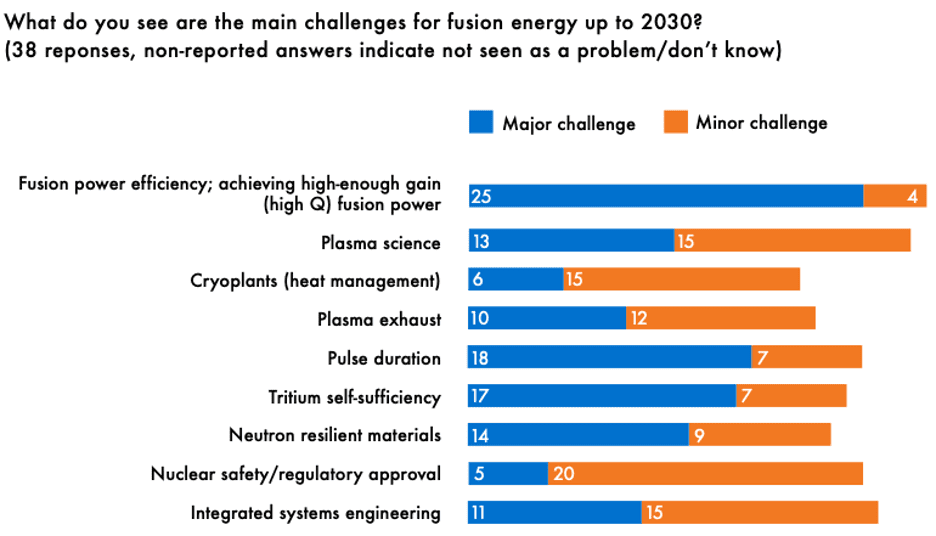
Claims of commercially viable fusion power being relatively imminent. Several companies have announced plans to build grid-scale commercial nuclear fusion power plants intended to come online in the early 2030s, according to the “The global fusion industry in 2025.” However, several challenges must be overcome to achieve commercial fusion energy. For instance, harnessing fusion energy still faces challenges such as physics of a plasma in combustion, heat extraction, manufacturing of sophisticated components such as the blanket, effect of 14-MeV neutrons on material. [1] below are some of the challenges facing commercialization of fusion energy technology up to 2030 identified in Fusion Industry Association’s The Global Fusion Industry in 2024 report.
Source. The Global Fusion Industry in 2024—Fusion Industry Association
Additional challenges are discussed in a 2023 technology assessment by the Government Accountability Office. [2] For instance,
“One key scientific challenge is in the physics of plasmas; the state of matter needed for fusion. Researchers do not fully understand the behavior of burning plasmas, those whose main source of heat is from the fusion reaction itself rather than an external source. Researchers have made advancements in this area but lack sufficient experimental data to validate their simulations. One key engineering challenge is the development of materials that can withstand fusion conditions for decades, such as extreme heat and neutron damage, and no facility exists where materials can be fully tested. More generally, the task of extracting energy from fusion to provide an economical source of electric power presents several complex systems engineering problems that have yet to be solved.”
A long-recognized drawback of fusion energy is neutron radiation damage to exposed materials, causing swelling, embrittlement and fatigue. [3] Plasma-facing components are materials and structures located at the inner walls of a fusion reactor, directly exposed to a large amount of heat energy transferred to a surface in a short period of time (high heat flux), energetic plasma and intense neutron irradiation. Notably, no existing material can simultaneously withstand all these extreme conditions for long-term operations. The commercial viability of fusion energy depends on developing plasma-facing components capable of enduring these harsh environments. [4]
Roadmaps and Resources
In 2024, the U.S. Department of Energy (DOE) Office of Science released its fusion energy vision, “Building Bridges: A Vision For The Office of Fusion Energy Sciences,” which identified three strategic actions to help bridge the interests of the private fusion energy sector and the public programs supported by the Office of Science: creating a U.S. Fusion Science & Technology Roadmap; establishing Fusion Innovation Research Engine Ecosystems; and developing a public-private consortium framework supporting fusion energy development.
In June 2024, the Office of Science released the “Fusion Energy Strategy 2024,” outlining its vision for the future of the Fusion Energy Sciences program. The strategy report organized DOE’s fusion energy goals into three high-level objectives: (1) closing science and technology gaps to a commercially relevant fusion pilot plant; (2) preparing the path to sustainable, equitable commercial fusion energy deployment; and (3) building and leveraging external partnerships. DOE is also developing a National Fusion Science and Technology Roadmap, to be released in the future, which focuses on closure of science and technology gaps to commercially relevant fusion pilot plants.
Other fusion energy Policy studies include the long-range plan issued in 2020 by DOE’s Fusion Energy Sciences Advisory Committee, titled “Powering the Future: Fusion and Plasmas”; a 2021 study by the National Academies of Sciences, Engineering, and Medicine, titled “Bringing Fusion to the U.S. Grid”; and a 2023 technology assessment by the Government Accountability Office, titled, “Fusion Energy: Potentially Transformative Technology Still Faces Fundamental Challenges.”
Funding
According to the Fusion Industry Association, most of its member companies believe that fusion can provide electricity to the grid by the end of the 2030s. However, getting there will require funding for technology development. Advanced technology firms often require funding to advance the maturation of their technology. Non-dilutive sources of funding opportunities are available from both the federal government and U.S. states. One can find federal funding opportunities in the form of research and development (R&D)solicitations and request for proposals announcements on grants.gov and sam.gov.
DOE’s Fusion Energy Sciences program (FES), within the Office of Science, is responsible for (1) understanding matter at high temperatures and densities, (2) building the knowledge needed to develop a fusion energy source, and (3) supporting the development of a competitive fusion energy industry in the U.S. FES primarily leads and funds fusion energy research, development, and commercialization within DOE.
FES is managing two ongoing initiatives intended to facilitate fusion energy commercialization through public-private partnerships: the Milestone-Based Fusion Development Program (Milestone) and the Innovation Network for Fusion Energy (INFUSE).
Milestone: FES announced the Milestone initiative in September 2022, which aims to advance designs and R&D for fusion pilot plants. The Milestone initiative required each applicant to propose a series of milestones toward designing a fusion pilot plant, and DOE funding is contingent upon meeting those milestones.
INFUSE: In kind funding rather than direct funding. FES began the INFUSE initiative in 2019 to provide fusion companies with access to technical expertise and resources at DOE laboratories to conduct fusion energy technologies R&D.
Another DOE program, the Advanced Research Projects Agency-Energy (ARPA-E) also supports energy technology R&D—including but not limited to fusion energy—that may otherwise be too high risk for private industry to undertake. [1] ARPA-E is managing two ongoing initiatives to support fusion energy research, development, and commercialization: Breakthroughs Enabling THermonuclear-fusion Energy (BETHE) and Galvanizing Advances in Market-Aligned Fusion for an Overabundance of Watts (GAMOW).
BETHE: The BETHE initiative aims to deliver lower-cost fusion energy options by advancing the performance of inherently lower cost but less mature fusion energy concepts.
GAMOW:. GAMOW is a joint initiative between ARPA-E and FES that aims to develop technologies and materials needed for fusion energy.
Other FES and ARPA-E initiatives to facilitate fusion energy commercialization include the following:
FIRE: Fusion Innovation Research Engine (FIRE) Collaboratives. Launched in May 2023 by FES, the FIRE Collaboratives initiative aims to advance foundational science towards practical application by addressing materials and technology gaps, such as breeding blankets.
CHADWICK: Hardened And Durable fusion first Wall Incorporating Centralized Knowledge (CHADWICK): ARPA-E announced the CHADWICK initiative in January 2024, which aims to develop materials for the chamber of a fusion device.
Other programs such as the Small Business Innovation Research (SBIR) and Small Business Technology Transfer (STTR), administered by 11 federal agencies can help de-risk early-stage technologies. Through a competitive awards, the SBIR and STTR enable small businesses to explore their technological potential and commercialization. To be eligible for the SBIR/STTR program, a company must be a United States-based, for-profit, small business with 500 or fewer employees, at least 51% U.S.-owned and controlled.
States, through their divisions of Economic Development also offer financial assistance to small companies in the form of matching funds, grants, loans, and venture funds.
Conferences and upcoming major events in 2025 and 2026
025 DIII-D Industry Event Day
November 14, 2025 – San Diego, California
67th Annual Meeting of the APS Division of Plasma Physics
November 17-21, 2025 – Long Beach, California
16th International Symposium on Fusion Nuclear Technology
November 9-14, 2025 – Knoxville, Tennessee
Fusion Industry Association Annual Policy Conference 2026
March 18-19, 2026 – Washington, DC
https://www.fusionindustryassociation.org/fia-annual-conference-2026/
IFE-STAR 2026 Conference
Washington, D.C. – March 22–27, 2026
2026 Innovative Concepts for Inertial Fusion Energy (IC-IFE)
May 20-22, 2026 – Livermore, California
American Nuclear Society 2026 Annual Conference
May 31–June 3, 2026 – Denver, Colorado
2026 IEEE International Conference on Plasma Science (ICOPS)
June 22 – 26, 2026 0 Lake Tahoe, Nevada
https://conferences.ieee.org/conferences_events/conferences/conferencedetails/53334
The Applied Superconductivity Conference (ASC 2026)
September 6 -11, 2026 – Pittsburgh, Pennsylvania
https://www.appliedsuperconductivity.org/asc2026/
Explore Other Energy Sources
Clean Coal
Stay in the Know with Dawnbreaker®
Receive valuable industry insights such as our Market Snapshots, SBIR/STTR & TABA updates, & webinar announcements.