SBIR/STTR Programs Are Finally Reauthorized!

SBIR/STTR Programs Are Finally Reauthorized!

On April 13, 2026 President Trump signed into law the Small Business Innovation and Economic Security Act. Unlike other reauthorizations which typically last for three years, this extends both programs and associated pilot programs for 5 years until September 30, 2031. Associated pilot programs include the Phase 0 Pilot Program, the Commercialization Readiness Programs, and others.

Although everyone can express a sigh of relief, it is important to keep in mind that it will take time to re-establish a timeline for the release of new solicitations across all of the participating agencies.  It is anticipated that the Department of War and the National Aeronautics and Space Administration will be among the first to release new solicitations. However, for those agencies which have experienced considerable change in their mission and/or staffing, it may take several months to release new solicitations.

Meantime, companies are encouraged to learn about the positive impact of new additions which reauthorization introduces including (1) Strategic Breakthrough Awards by which larger agencies can provide companies up to $30M post Phase II funding over a four year period, assuming companies have outside matching funds, (2) the requirement of Technical and Business Assistance (TABA) to be provided by all agencies and which will allow company staff, as well as external consultants to conduct TABA activities. In addition, I-Corps training can be paid for using TABA funds; and (3) a new emphasis on Phase III awards for companies working with contracting agencies.

Other changes with which small businesses should become familiar are Foreign Influence disclosures and annual proposal limits, which will vary by Agency.

Open Letter to the House and Senate Small Business Committees

Open Letter to the House & Senate Small Business Committees

Reauthorization of the SBIR/STTR Programs

The SBIR/STTR small business community is in pain!  Some companies have already passed away; others are at death’s door. While Congress continues to delay reauthorization of the Small Business Innovation Research (SBIR) and Small Business Technology Transfer (STTR) programs[i], the advanced technology community continues to agonize.

For decades there has been a reliable rhythm to the SBIR/STTR programs: a time when agencies released their Phase I and Phase II solicitations; a time when notification of awards was made. Mandated by Congress, agencies have been expected to notify companies of award within 90 days of the stated proposal submission dates[ii]. This rhythm is gone; there is no predictability; there are no notifications; only questions and delays.

Some of this has nothing to do with reauthorization, but with the changes in Agency missions. It takes time to change organizations, to secure new staff as others depart and to decide upon topics that align with new directions. These changes began in January 2025 and still little information is forthcoming. Some companies are waiting to hear if proposals submitted in February have been awarded. Others are waiting to hear when Phase II solicitations originally scheduled for release in early FY26 will actually be released.

Delays and uncertainties have many companies living on a razor’s edge. In order to reduce technical risk, Phase II funding is required to achieve Technology Readiness Level (TRL) 6 or higher. Without reducing technical risk, investments and partnerships won’t happen…and while waiting, some companies will collapse as there is a limit to how much personal financial risk founders can absorb.

Failure to reauthorize the SBIR/STTR programs will be the nail in the coffin for an increasing number of small businesses! Without reauthorization, delays will continue.  It will take years for the participating agencies to once again establish a rhythm for their programs and for small business to regain their footing. House bill H.R. 3169, officially titled the “SBIR/STTR Reauthorization Act of 2025” reflects a true understanding of the SBIR/STTR community and the challenges that they face in commercialization. However, reauthorization is delayed due to the desire to include a number of items originally in the INNOVATE Act (Senate bill, S.853).

One of the items being debated is the introduction of Phase 1a. However, Phase 1a does not acknowledge the fact that agencies such as the Department of Energy through its Phase 0 program and the National Institutes of Health through its Applicant Assistance program have been providing effective proposal preparation services for new companies for many years using funds allocated for Agency Outreach. Implementation of Phase 1a would eliminate funding for these existing and effective programs which are offered at a quarter of the proposed cost for Phase 1a. In addition, agencies such as the National Science Foundation have since 2019 taken extra steps to help new companies through the addition of a Project Pitch mechanism, as well as their outreach initiatives. Thus, participating SBIR agencies have shown they are capable of innovative enhancements to their programs. They do not need Congress tying up re-authorization with its own additions.

The 119th United States Congress is on track for becoming the most anti-small business Congress on record. To dismiss this legacy, to enable the agencies to do their job and America’s small, advanced technology community to survive, Congress should immediately re-authorize the SBIR/STTR programs for one year. Permanent authorization should follow.

[i] For a brief introduction to the history and purpose of the SBIR/STTR program, please consult “The History of the SBIR and STTR programs,”

[ii] See the 2022 Annual Report to Congress, pages 55 and 57 for more information regarding the number of days between solicitation close and award notification by agency.

Email
Twitter
LinkedIn

Federal Agencies Also Suffer Without SBIR/STTR Reauthorization

Federal Agencies Also Suffer Without SBIR/STTR Reauthorization

By Jenny C. Servo, Ph.D.

The failure of Congress to reauthorize the Small Business Innovation Research (SBIR) and the Small Business Technology Transfer (STTR) programs has brought these initiatives to a complete standstill. This adversely affects, not only the small, advanced technology firms, but also the federal agencies which utilize these programs as a resource for needed innovations.

Historically, the Department of Defense (DoD), the Department of Homeland Security (DHS) and the Department of Energy (DOE) release a Phase I Pre-solicitation or solicitation during the first quarter of the Fiscal Year (October 1 – December 31, 2025). These solicitations are currently at risk due to failure to reauthorize the SBIR/STTR programs now, as these programs lapsed on October 1, 2025. Although DoD has multiple Phase I solicitations during the fiscal year, DHS has only one during the first quarter, and DOE has two, neither of which has yet been released. This is a hardship for small businesses that are counting on the opportunity to compete for an SBIR/STTR award from these important programs.

What many Congressional staff don’t understand is that the eleven federal agencies also depend on the SBIR/STTR programs to advance their innovations. This is accomplished through the needs articulated in the solicitations which the agencies themselves prepare. Having access to a ready bastion of small, advanced technology firms that can address national needs is important to the federal agencies and for maintaining U.S. competitiveness. To put this in perspective, in the 1980’s General Abrahamson, the first director of the Strategic Defense Initiative (SDI) Organization is quoted as stating that SDI would require approximately 200 innovations to accomplish its mission. It is often stated that the need for such innovation was a factor that led President Reagan to endorse the Small Business Development Act in 1982. Today, the United States’ federal innovation ecosystem still relies heavily on the nation’s small businesses to address agency needs.

In part, reauthorization is stymied because of two issues (1) the first, relates to opinions regarding frequent, award winners, and (2) the second, the venture capital model. Those that oppose the ability of companies to win frequent awards, assume that these “mills”, prevent new entrants from winning SBIR/STTR awards. However, those making this claim, do not ask to see the agency data on proposals from new applicants to determine if they are competitive. Frequent award winners, win large numbers of awards because of their strengths in realizing technological innovations. Their success is based on merit and the fact that they have demonstrated to their agency customers that they can reliably provide them with innovative solutions in a timely fashion. Just as it would seem foolish to tell Lockheed Martin, you can’t win another award, because you have received too many – it does not make sense to take this stance, with innovative small businesses which have demonstrated their competence.  Ultimately most of these firms, leave the SBIR program through an acquisition.

The second issue holding up SBIR/STTR reauthorization appears to be the desire to insert the venture capital model into this program. However, the beauty of the SBIR/STTR programs is that they attract talented scientists and engineers who are willing to take a personal risk to start their own business. By contrast, venture capital firms wait until technological and management risk are reduced before investing and as the market is beginning to rapidly grow. Venture capital is an option that businesses consider as they mature. However, to meet the objectives of federal agencies, the SBIR/STTR programs should remain funded by the federal agencies which determine their needs, make award decisions based on merit and do not take any equity in the small business.

To address well, the changes in emphasis that every federal agency is experiencing today, the SBIR/STTR programs must be reauthorized immediately, so that federal agencies can proceed with articulating these priorities in solicitations and so that the infrastructure that has been developed to conduct these programs to benefit the U.S. economy can proceed.

Time is of the essence. Congress needs to reauthorize the Small Business Innovation Research (SBIR) and Small Business Technology Transfer programs immediately!

Jenny C. Servo, Ph.D. is the President and Founder of Dawnbreaker, a woman-owned small business located in Rochester, NY which has provided commercialization assistance to SBIR/STTR awardees since 1990.

Email
Twitter
LinkedIn

OTAs Boost DOD’s Ability to Acquire nnovative technologies

The Department of Defense (DOD), also known as the Department of War (DOW), is increasingly using Other Transaction Agreements (OTAs or OTs) as a mechanism for research, development, test & evaluation (RDT&E) and initial production activities. DOD’s OTA spending went from under $1 billion in FY 2015 to $18 billion in FY 2024. Issued in April 2025, Executive Order 14265: Modernizing Defense Acquisitions and Spurring Innovation in the Defense Industrial Base, directs DOD to make a number of acquisitions reforms focused on improving speed and flexibility, including prioritizing OTAs and similar vehicles.

OTAs are meant to boost DOD’s ability to acquire innovative technologies, especially from nontraditional defense contractors and small businesses. OTAs, not subject to certain federal acquisition laws and requirements, are more agile contracting vehicles with more flexibility in the award process and contract terms and conditions. There are three types of OTAs: research OTAs, prototype OTAs, and follow-on production OTAs. Most are prototype OTAs, which offer a streamlined method for transitioning into production without further competition. All branches of DOD can use OTAs -. The Army has made the most use of OTAs by far, followed by the Air Force. (Some other federal agencies, such as NSF, have similar other transaction agreement authority.)

DOD can award OTAs to individual organizations (for-profit or non-profit) or to consortia—groups of organizations focused on specific technology areas. The majority are awarded through consortia. DOD awards consortia OTAs and directs the consortia to handle different aspects of the awards process for individual projects. An organization must be a member of the consortium to be eligible for project awards through that consortium. Examples of major DOD consortia include:

Download our OTA Report!

Fill out the form to download a copy of our Other Transaction Agreements (OTA) report.

*By submitting this form you agree to receive updates from Dawnbreaker.

Defense Portal: A One-Stop Resource for U.S. Navy Insights

In an environment where information changes quickly and accuracy is critical, access to reliable, consolidated resources can be the difference between informed decisions and missed opportunities. Dawnbreaker’s Portals were created with this very challenge in mind: to deliver reliable, concise, and continuously updated information to those working with, or seeking to better understand, the U.S. Navy.

As one of the most complex organizations in the world, the U.S. Navy’s structure includes commands, program offices, and leadership roles that evolve regularly. Finding accurate, up-to-date details about its structure and leadership often required hours of research across multiple websites, reports, and announcements.

Dawnbreaker’s Defense Portal eliminates this challenge by providing:

For anyone navigating Navy programs—whether government, industry, or academia—the Defense Portal offers a streamlined path to reliable insights.

The importance of staying current cannot be overstated. Leadership transitions directly impact priorities, decision-making, and program direction. We’re pleased to share that as of September 2025, the Defense Portal has been updated to reflect recent significant leadership changes. As leadership shifts and new challenges emerge, this resource ensures that you stay informed—saving time, reducing uncertainty, and helping you move forward with confidence. Key personnel roles are and will continue to be regularly reviewed and updated to maintain the highest standard of current information.

Will the Senate allow the SBIR/STTR programs to lapse TODAY?

For over 43 years, the House and the Senate have acted together to assure that the Small Business Innovation Research (SBIR) and the Small Business Technology Transfer (STTR) programs do not lapse. Now, at the last minute – the Senate appears to be hesitating in approving bill HR 5100 unanimously presented by the House which extends the SBIR/STTR programs for one year. “This bill simply pushes the termination date back to September 30, 2026, and makes no programmatic changes to the program.” This will allow time in the future to evaluate any proposed changes.

However, if the program is allowed to lapse today, no new SBIR/STTR awards can be made, no new solicitations will be released and countless small, advanced technology firms will be damaged. We encourage the Senate to pass HR 5100 today!

The Negative Impact of the Department of Energy (DOE) 15% Overhead Rule on SBIR/STTR firms

The Negative Impact of the Department of Energy (DOE) 15% Overhead Rule on SBIR/STTR firms

The implementation of the 15% rule applied to the Department of Energy’s Small Business Innovation Research (SBIR) and Small Business Technology Transfer (STTR) programs will inadvertenty cripple the innovation for which this program has been justly recognized. In May 2025, the Department of Energy’s Office of Acquisition Management issued three Policy Flashes (PF) which limit the indirect rates allowed for grants and cooperative agreements. Collectively, these documents affect (1) nonprofits – in particular Institutions of Higher Education (PF 2025-26), (2) for profits – including both large and small business (PF 2025-27) and (3) state and local government (PF 2025-25). The stated purpose of the Policy Flashes is to improve efficiency and curtail costs where appropriate. PF 2025-27 clarifies that “The Department seeks to better balance the financial needs of financial assistance award recipients with the Department’s obligation to responsibly manage federal funds.”

However, what is left out of this balance is the profound and negative impact that this ceiling will have on small, advanced technology firms participating in DOE’s Small Business Innovation Research (SBIR) and Small Business Technology Transfer (STTR) programs. It will stifle their ability to advance DOE SBIR/STTR funded technologies into cutting edge, commercial products

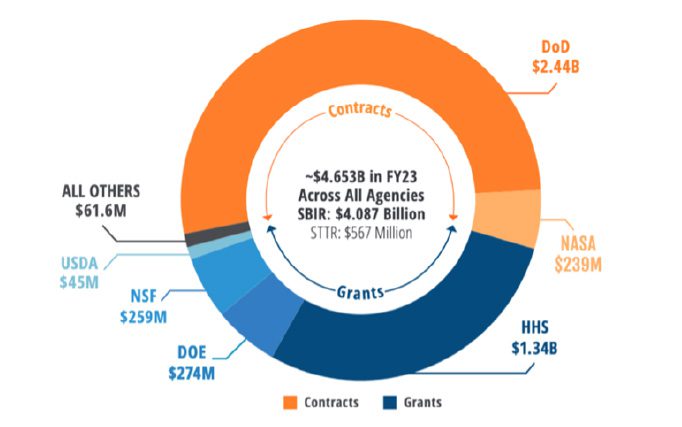
Funding for the SBIR/STTR programs comes out of extramural research and development funds. The federal government spent approximately $192 billion in FY23 on research and development.  According to the National Science Board two-thirds of the FY23 federal R&D budget ($128 billion) went to extramural performers, while the remainder ($64.1B) went to intramural performers.  Extramural performers include the three categories affected by the DOE Policy Flashes. In FY23, only $4.65B of the $128B spent on extramural R&D went to small business participating in the SBIR/STTR programs[1]. DOE which provides its SBIR/STTR awards as grants, accounted for just 5.89% of the total SBIR/STTR budget in FY23.

 Figure 1: FY2023 SBIR/STTR Budgets by Agency

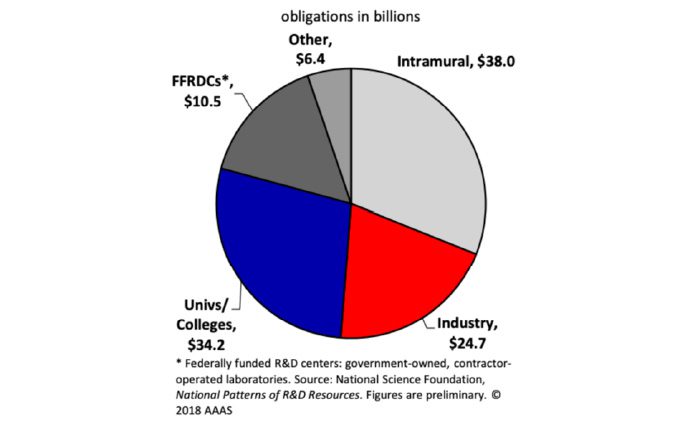
The amount of R&D funding that went to large business in FY23 is not readily available. However, one can gain insight into this information from a 2019 AAAS report. The following figure represents the distribution of federal R&D funding in FY16. The total amount of federal R&D funding spent on both intramural and extramural performers in FY16 was $113.8B. Of that total, $38B was spent on Intramural R&D, leaving $75.8B or 66% for extramural R&D. The combined SBIR/STTR budget in FY16 was $2.38B[2]. This represents 10.8% of the total extramural funding spent on industry ($24.7B) in FY16.

 Figure 2: Federal R&D by Performer, FY2016

Most extramural R&D funding is awarded to LARGE business, not to small SBIR/STTR funded firms. I can’t speak to the ability of large business to absorb a 15% indirect cost ceiling. However, the mission of small, advanced R&D firms focused on basic and applied research limits their ability to supplement a 15% indirect cost ceiling. A potential side effect of  PF 2025-27 is that DOE will lose some of its more seasoned performers to other Agencies participating in the SBIR/STTR program that use contracts as opposed to grants.

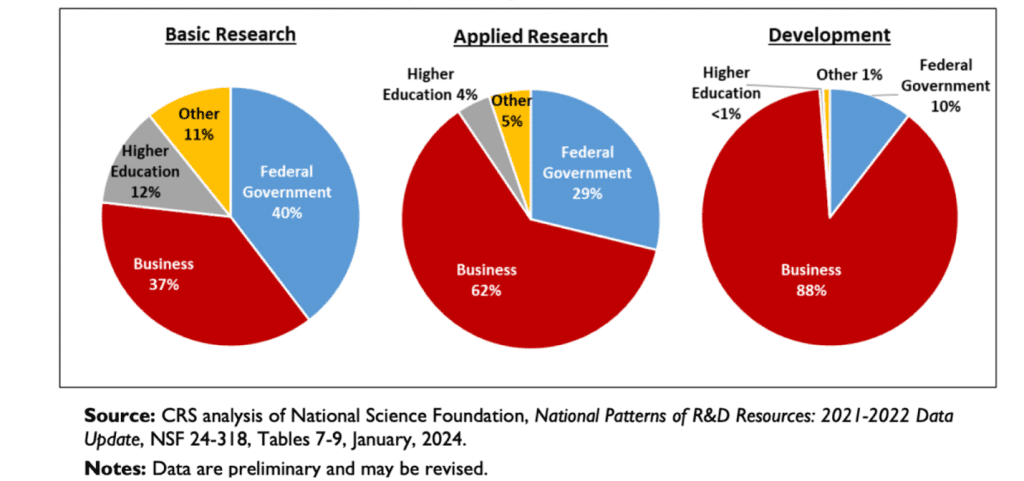
Although large business invests in R&D, studies conducted by the National Center for Science and Engineering Statistics indicate that the preferred model for large business  is to have high-risk, basic and applied research funded by the federal government and then become involved when the technology is de-risked at the development stage (TRL 6-9). When the technology is sufficiently mature, the smaller entities could be acquired by a larger firm, intellectual property licensed-in, or joint ventures formed.

 Figure 3: Composition of U.S. Basic Research, Applied Research and Development by Funding Sector, 2022.

PF 2025-27 states that “The Department plans to establish a maximum allowable dollar amount (stated in terms of a percentage of the total project award amount) that it will reimburse for allowable, allocable, and reasonable indirect costs under Awards. The percentage that will be reimbursable is inclusive of total indirect costs and fringe benefit costs.”

The 15% which is recommended in PF 2025-27 has historically been the de minimis and applies when the recipient does not have a current federal negotiated indirect cost rate. In practice, this tends to be used by start-ups which are often first-time applicants with minimal infrastructure. Start-ups with 1-3 employees use the de minimis rate as it does not require any back-up data. Fifteen percent of a Phase I DOE SBIR award of $200,000 is $30,000. Although this may sound like a lot to someone who has not run a business – health care benefits alone would take half of that in one gulp. If the company is a start-up working out of their home with minimal infrastructure, they might be able to make that work for their first year.

However, to grow a business so that it has the resources to both develop and commercialize a technology requires that a company add business functions and physical infrastructure. Gere Glover,  the Executive Director of the Small Business Technology Council  notes that the average indirect rate for maturing Department of Energy SBIR/STTR companies is approximately 50%. The 7% profit typically allowed to an SBIR/STTR firm by the Department of Energy cannot make up for the shortfall that the imposition of this 15% indirect rate will create. Implementation of this policy will damage their future and the ability of these companies to remain good suppliers of innovative technology to the Department of Energy.

PF 2025-27 states that “In circumstances where the Secretary has determined it is necessary and appropriate, the dollar threshold for payment of indirect costs may be modified for Award(s) to for-profit organizations that are subject to this policy.”

Grouping large and small businesses together that receive extramural R&D funds from the Department of Energy and then applying one indirect rate to all, ignores significant differences between large and small business. Large well-managed companies are financially stable and have an established and diverse infrastructure built over decades.  They have personnel dedicated to product development, marketing and sales, distribution, manufacturing, quality, legal and the like. Large businesses make profit from the products that they sell and have cash reserves.

For small, advanced technology firms to become and remain viable entities on the path to financial independence requires time and resources. Examples of the typical expenses an SBIR firm must cover are available in examples that DOE provides small business on how to develop indirect cost models.[1] In this document a sample ledger provided by DOE depicts a 32% fringe rate and a 12.2% Indirect rate for a total of 44.2%, when combined. Funding is the life blood of a company and a 15% indirect rate is inadequate for a small, advanced technology firm.

Given the importance of the innovation that stems from the SBIR/STTR program to the Trump Administration, it is respectfully suggested that indirect rates for companies participating in the SBIR and STTR program be considered for separate benchmarks established after an analysis of historical data on SBIR/STTR indirect rates.

[1] The FY2011 reauthorization of the SBIR program increased the set aside to 3.2% of the extramural R&D budget and 0.45% for the STTR program.


[2] Small Business Administration, “ SBIR/STTR 2016 Annual Report to Congress,” 2019


[3] DOE National Technology Laboratory, “Negotiated Indirect Cost Rate Agreement and Indirect Rate Proposal Guidance,” https://netl.doe.gov/sites/default/files/2024-09/Negotiated-Indirect-Cost-Rate-Agreement-and-Rate-Proposal-Guidance.pdf

Share this article:

Email
X
LinkedIn

The INNOVATE Act: The Problems with Phase 1A

The Innovate act: The problems with Phase 1A


By Jenny C. Servo, Ph.D.

The Department of Defense has developed numerous ways to modify the Small Business Innovation Research (SBIR) and Small Business Technology Transfer (STTR) programs to rapidly secure solutions for the warfighter. From Commercial Solutions Offerings (CSO) to $50,000 Phase I awards that make a company instantly eligible for a government Phase III, DoD has demonstrated its ability to use both traditional and nontraditional methods to secure technologies that it needs for the warfighter more rapidly.

However, it appears that some small businesses that have benefited from the application of DoD’s tool kit, often become proponents of applying these same methods to all agencies. For example, the Phase 1A concept in the INNOVATE Act bears a striking resemblance to DoD’s Commercial Solutions Offering (CSO).  This is an optional approach used by DoD – not a mandated one – which enables companies with an existing commercial solution to make modifications to meet a DoD need.“CSO can be used to acquire innovative commercial items, technologies, or services that directly meet program requirements, whereas BAAs are restricted to basic and applied research.[1]

The proposed Phase 1A is intended to speed upon the entry of new applicants into the SBIR/STTR programs, by asking them to submit a two-page proposal in response to an “open topic” for which they could receive a $40,000 award. The proposed guidelines for the Phase 1A application includes: (1) Identification of the Problem, (2) Description of the Solution, (3) Impact of the Solution, (4) Differentiation and (5) Commercialization Strategy including both the commercial and government markets. The requirement for an “Open Topic” and the proposed outline suggests that very little is known about how civilian agencies differ from the Department of Defense. Here are a few of the differences:

    1. Most of the SBIR/STTR topics from civilian agencies ARE focused on basic and applied research.
    2. Many civilian agencies already have developed their own methods to quickly enable potential applicants to discern if there is a fit between their skills and the agencies needs. The National Science Foundation uses the Project Pitch, the Department of Energy uses the Letter of Intent, and the National Institute of Health uses Aims.
    3. Civilian agencies already conduct outreach to bring in hundreds of new applicants each year and provide support in proposal preparation through federally funded Phase 0 programs. The Department of Energy has provided the DOE Phase 0 support for more than 10 years, as has the National Institutes of Health through its Applicant Assistance Program. These programs are comprehensive and cost effective.
    4. Most civilian agencies have funded I-Corps and make this available in various forms in order to assure that small businesses speak with their potential customers.
    5. Although Government Phase IIIs are theoretically available to all agencies, granting organizations tend not to use this mechanism as their mission is focused on “public good”, as opposed to being focused on a government mission.

The bottom line is that there is no need to substitute effective solutions that agencies have already developed with an approach that will overwhelm their staff and require more taxpayer money. Existing federal Phase 0 programs cost between $5,000 and $7,000 per company, as opposed to $40,000 as proposed by the INNOVATE ACT.  It is important to note that the Department of Defense, which accounts for more than half of the available SBIR/STTR funding, has far more staff to manage and implement its programs than smaller agencies with less resources.

The INNOVATE ACT maintains that “Phase 1A funds will bring thousands of new small business concerns committed to commercialization of critical technologies into the SBIR program.” However, there are no data to substantiate this belief, even though the argument is being made that by placing a cap on the number of awards that frequent award winners receive, an increase in first time applicants winning SBIR/STTR awards will increase.  However, the Annual SBIR/STTR Reports to Congress, provided by the Small Business Administration do not include any data regarding how many first-time applicants submit SBIR/STTR proposals,  how many of these were non-responsive, merited award or received an award. Such data are necessary to substantiate this assumption.

It is therefore suggested that in bill S. 853 “Phase 1A be presented as an option, rather than a mandate and that all agencies be required to use not less than 2.5% of their SBIR budget for either Phase IA or other outreach initiatives aimed at bringing in qualified, first time SBIR/STTR applicants. Existing Federal Phase 0 programs are funded with “outreach” dollars which would be eliminated by a mandated Phase 1A requirement.

[1] DAU, Commercial Solutions Opening (DFARS 212.70), accessed August 20, 2025

Jenny C. Servo, Ph.D. is the President and Founder of Dawnbreaker, a woman-owned small business located in Rochester, NY which has provided commercialization assistance to SBIR/STTR awardees since 1990.

Email
Twitter
LinkedIn

Don’t Kill the Golden Goose!

Don’t Kill the Golden Goose!

By Jenny C. Servo, Ph.D.

In July 2022 Congress passed the sweeping Domestic Semiconductor Manufacturing Act[1] to ensure U.S. competitiveness and dominance in this critical technology. This need harkens back to the 1970’s when the same concern regarding U.S. competitiveness gave rise to the Small Business Innovation Research (SBIR) program. However, the response today is different – in 2022, Congress is heading towards the potential lapse of the SBIR/STTR programs due to its inaction!

What is so unnerving is that Congress apparently doesn’t know the role that the SBIR/STTR programs have already played in strengthening the domestic semiconductor industry – through a small, SBIR-funded company called Arkansas Power Electronics International (APEI) which was acquired by Cree (NASDAQ: Cree) in 2015 and today is known as Wolfspeed.  The future of the semiconductor industry lies with wide band gap materials – SiC and GaN and Wolfspeed is the world leader.

SiC Wafer Market Share

Source: Wolfspeed, pg 80.

At the time APEI was acquired in 2015, the Executive Vice President of Cree stated,

“Adding this expert team of innovators and portfolio of patents will enable us to further disrupt and expand the market,” said Frank Plastina, executive vice president, Cree Power and RF. “Extending our research and development capabilities with APEI, a leader in wide bandgap power R&D, will help us accelerate delivery of a full spectrum of SiC power modules to meet customer requirements for performance and cost.”[2]

Two days ago Wolfspeed announced a ”$5 Billion investment in Chatham County, largest in NC History”[3] to build a new semiconductor plant.

To put the role of the SBIR program in perspective here are a few data points. Arkansas Power Electronics International was founded in 1997 and between 2002 and 2015 received 59 Phase I and Phase II awards which included: 29 awards from the Department of Defense; 13 awards from the Department of Energy, 14 awards from the National Aeronautics and Space Administration, one award from the Department of Transportation and one award from the National Science Foundation. This level of support for revolutionary technologies by the SBIR/STTR programs is necessary. To simply assume that providing multiple awards to a small business is a waste of tax-payer money or that this practice prevents other companies from winning SBIR/STTR awards is simply false.  

This is one of the many SBIR/STTR successes that goes unheralded as federal agencies lack sufficient funding and tools to track the success of SBIR/STTR awardees over an extended timeframe.  Since 1982, many successful technologies funded though the SBIR/STTR programs have enhanced U.S. competitiveness, created jobs, and commercialized new products. Congress needs to take appropriate measures immediately to keep the SBIR/STTR programs in place. To let this program lapse will hinder U.S. competitiveness – which is the reason the SBIR program was initially created [4] and should be allowed to flourish!

Jenny C. Servo, Ph.D. is the President and Founder of Dawnbreaker, a woman-owned small business located in Rochester, NY which has provided commercialization assistance to SBIR/STTR awardees since 1990.

Email
Twitter
LinkedIn